- Köchel Number
- K9 537 | K6 537
- Genre
- Concertos
- Form
- Piano Concertos
- Key
- D Major
- Date
- 24 February 1788
- Place
- Vienna
- Age
- 32
Mozart’s Piano Concerto No. 26 in D major, K. 537 is widely known as the “Coronation” Concerto, a nickname added by a publisher after Mozart played it at coronation festivities. This article covers its context, scoring, three-movement form, and the autograph’s unusually incomplete solo part.
Composition & Context
Wolfgang Amadeus Mozart completed his Piano Concerto No. 26 in D major, K. 537 on 24 February 1788[1]. This was his penultimate piano concerto, written during his later years in Vienna when public demand for his concerts was declining and his finances were strained[2][3]. In fact, Mozart had planned to introduce this concerto in Vienna during the 1788 Lenten concert season, but the series was never realized; there is no evidence of a public Vienna performance of K.537 in Mozart’s lifetime[4].
The popular nickname “Coronation” was not Mozart’s own. It was added by a publisher (likely as a marketing device) to capitalize on Mozart’s having performed this concerto during the festivities for the coronation of Emperor Leopold II in October 1790[5]. Mozart was not officially hired for the coronation events, but he arranged an independent concert in Frankfurt on 15 October 1790 (at his own expense) where he played this concerto, along with an earlier D-major concerto (No. 19, K.459)[6][7]. The association with that royal occasion earned K.537 its enduring “Coronation” moniker.
Instrumentation
Mozart scored the concerto for a solo piano and a classical orchestra consisting of:
Woodwinds: 1 flute, 2 oboes, 2 bassoons
Brass: 2 horns, 2 trumpets
Percussion: Timpani (in D and A)
Strings: Violins, violas, cellos, and double basses
[8][9]
This full, festive orchestration – notably including trumpets and timpani – gives the concerto a bright, ceremonial character suited to its nickname. (By contrast, Mozart included no clarinets, and the woodwinds mainly reinforce harmonies; the D major key, with its traditional martial and celebratory associations, was an apt choice for regal festivities[10].)
Form & Musical Character
Mozart’s Piano Concerto No. 26 follows the conventional three-movement fast–slow–fast structure: I. Allegro (D major); II. Larghetto (A major); III. Allegretto (D major)[11]. The first movement is in an adapted sonata-allegro form typical of Mozart’s concertos, often described as “concerto-ritornello” or double-exposition form[12]. It opens with the orchestra presenting the principal themes (a stately, fanfare-like first theme and a flowing second theme) before the piano enters with its own exposition of these ideas[13]. The movement features a relatively loose, episodic structure by Mozart’s standards: the orchestral introduction contains several connecting passages that emphasize melody over strong key modulation, resulting in a more free-form, galant flow of ideas[14]. This approach “loosens” the harmonic framework, and in place of intense tonal drama Mozart provides abundant virtuosic figuration for the piano, including rapid scales, arpeggios and an improvised cadenza near the end[15][16]. The overall mood is brilliant and celebratory, with a graceful rococo elegance that made the work immediately accessible and pleasing to audiences[17].
The second movement, Larghetto in A major, offers a gentle contrast. It is a lyrical slow movement cast in ternary (ABA) form[18]. The piano introduces a tender, singing theme, which the orchestra and soloist then elaborate in a conversational manner. The texture here is intimate and expressive, highlighting Mozart’s melodic gift and subtle ornamentation. A contrasting middle section in a minor or varied mode provides some tension before the opening material returns, ending the movement with understated warmth.
The final movement, Allegretto, returns to D major and is written in a rondo form with sonata elements – essentially a sonata-rondo design[19]. Its jaunty main theme (Section “A”) recurringly alternates with intervening episodes (B, C, etc.) in the pattern ABACBA, a common layout for Mozart’s late concerto finales[19]. This movement has a light, playful character and plenty of spirited, bravura passages for the soloist. The piano and orchestra engage in lively exchanges, and the concerto concludes with a brilliant flourish.
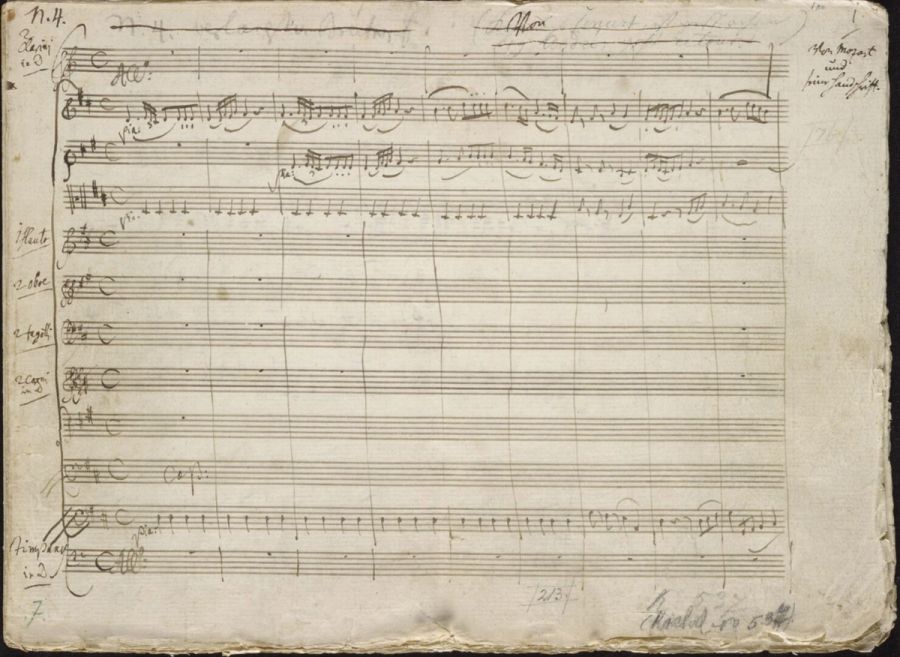
Notable Features: Unusually, Mozart did not fully write out the solo piano part in the autograph manuscript for this concerto. Large stretches of the left-hand accompaniment – including the entirety of the Larghetto movement – were left blank in Mozart’s score[20]. He likely improvised these simple Alberti-bass patterns and harmonies during performance, a testament to his prowess as a keyboard artist. (When the concerto was first published in 1794, the editor Johann André filled in these missing left-hand parts in print[21].) It is also noteworthy that Mozart’s autograph lacks tempo indications for the second and third movements (the markings “Larghetto” and “Allegretto” were later added by someone else)[22]. These quirks suggest Mozart prepared K.537 primarily for his own use in concert, relying on his spontaneity to complete the details in real time. They make the “Coronation” Concerto unique in Mozart’s output, being the only one where so much of the solo part was left to the performer’s interpolation[20].
Stylistically, the concerto stands somewhat apart from Mozart’s other late Viennese concertos. It has a lighter, courtly character and prioritizes tuneful charm and virtuoso brilliance over the more integrated symphonic development found in some of his earlier masterpieces. Some analysts have observed that K.537 depends less on rigorous harmonic tension and more on “melodic succession” to shape its movements, even labeling it “proto-Romantic” for its emphasis on virtuosity for its own sake[23]. In other words, Mozart here showcases the soloist in a brilliant, almost showpiece manner that foreshadows the 19th-century Romantic concerto ethos, though within a Classical framework.
Reception & Legacy
Contemporary Reception: In Mozart’s day, the D-major “Coronation” Concerto was very well received. Viennese and imperial audiences enjoyed its beauty, graceful galant style, and easy brilliance[17]. The work’s festive tone and clear, amiable themes were readily appreciated; it was neither as intense nor as complex as some of Mozart’s other concertos, which made it immediately attractive to a broad public. Mozart himself found opportunities to perform it at prestigious occasions (as noted, in Dresden and Frankfurt), indicating it was a showpiece he trusted to impress listeners.
Critical Opinion and Popularity: Over time, the concerto’s reputation has seen shifts. Throughout the 19th century, K.537 was in fact one of Mozart’s most famous piano concertos – it was frequently performed and beloved by audiences. Even as late as 1935, musicologist Friedrich Blume could call it “the best known and most frequently played” of all Mozart’s concertos[24]. However, 20th-century critics became more ambivalent. Many scholars and connoisseurs came to rank the “Coronation” somewhat below Mozart’s dozen earlier Viennese concertos (Nos. 14–25) or his final concerto (No. 27), criticizing K.537 for what they perceived as a simpler, less profound musical structure[25]. The orchestral writing is comparatively straightforward (the winds mostly doubling the strings), and there is considerable repetition, leading some to dismiss the piece as brilliant but shallow. The distinguished Mozart biographer Alfred Einstein, for example, admired the concerto’s easy charm but felt that “while it is very Mozartean” and “brilliant and amiable,” it “does not express the whole or even the half of Mozart” – suggesting that the work lacks the full depth and innovation of Mozart’s greatest compositions[26]. In Einstein’s colorful phrase, “in it Mozart imitated himself”[26], implying a reworking of familiar formulas rather than bold new inspiration.
On the other hand, modern performers and scholars have urged a reappraisal of the “Coronation” Concerto. Mozart authorities today hold differing views: some still see it as regressive or old-fashioned relative to his 1780s peak, but others argue that this concerto is actually innovative in its own way[27]. They point out its novel features – the profusion of virtuoso piano writing, experimentation with form, and the relaxed, expansive use of melody – as evidence that Mozart was exploring new directions, perhaps anticipating the Romantic concerto idiom[28]. In recent decades the piece has remained an enduring staple of the Mozart repertoire[29]. It is regularly programmed and recorded, and many pianists have championed its merits. Notably, acclaimed Mozart interpreter Mitsuko Uchida (echoing conductor Sir Colin Davis) has described the K.537 concerto as an “underrated masterpiece,” one whose sparkling surface may conceal greater subtleties than it first appears[30]. Indeed, despite past criticisms, the "Coronation" Concerto continues to delight modern audiences and performers alike – a work of brilliant charm and ceremonial splendor that still holds a special place among Mozart’s concertos.
Sources:
Sources
Mozart’s autograph score of K.537 is preserved in the Morgan Library in New York[31], and modern editions (such as the Neue Mozart-Ausgabe) distinguish Mozart’s original notation from the later editorial additions in the piano part[32]. The concerto’s unique historical context and its mix of Classical grace and virtuosity ensure that it remains a subject of interest in musicological discussion, as well as a favorite in concert halls around the world.
[1][6][8][11][17][20][21][22][24][25][26][31][32] Piano Concerto No. 26 (Mozart) - Wikipedia
https://en.wikipedia.org/wiki/Piano_Concerto_No._26_(Mozart)
https://ppublishing.org/media/uploads/journals/article/EJH_3_2023_p3-7.pdf
[5][9][12][13][16][18][19][27][28][29] Mozart / Piano Concerto No. 26 | Manitoba Chamber Orchestra
https://themco.ca/education/listening-guides/mozart-piano-concerto-no-26
[7][14][15][23] Piano Concerto No. 26 in D, K. 537 "Coronation", Wolfgang Amadeus Mozart
https://www.laphil.com/musicdb/pieces/2766/piano-concerto-no-26-in-d-k-537-coronation
[30] Mitsuko Uchida Discusses Mozart - Classic FM
https://www.classicfm.com/artists/mitsuko-uchida/news/mitsuko-uchida-discusses-mozart/