- Köchel Number
- K9 453a | K6 453a
- Genre
- Piano Music
- Form
- Piano Pieces
- Key
- C Minor
- Date
- 1784
- Place
- Vienna
- Age
- 28
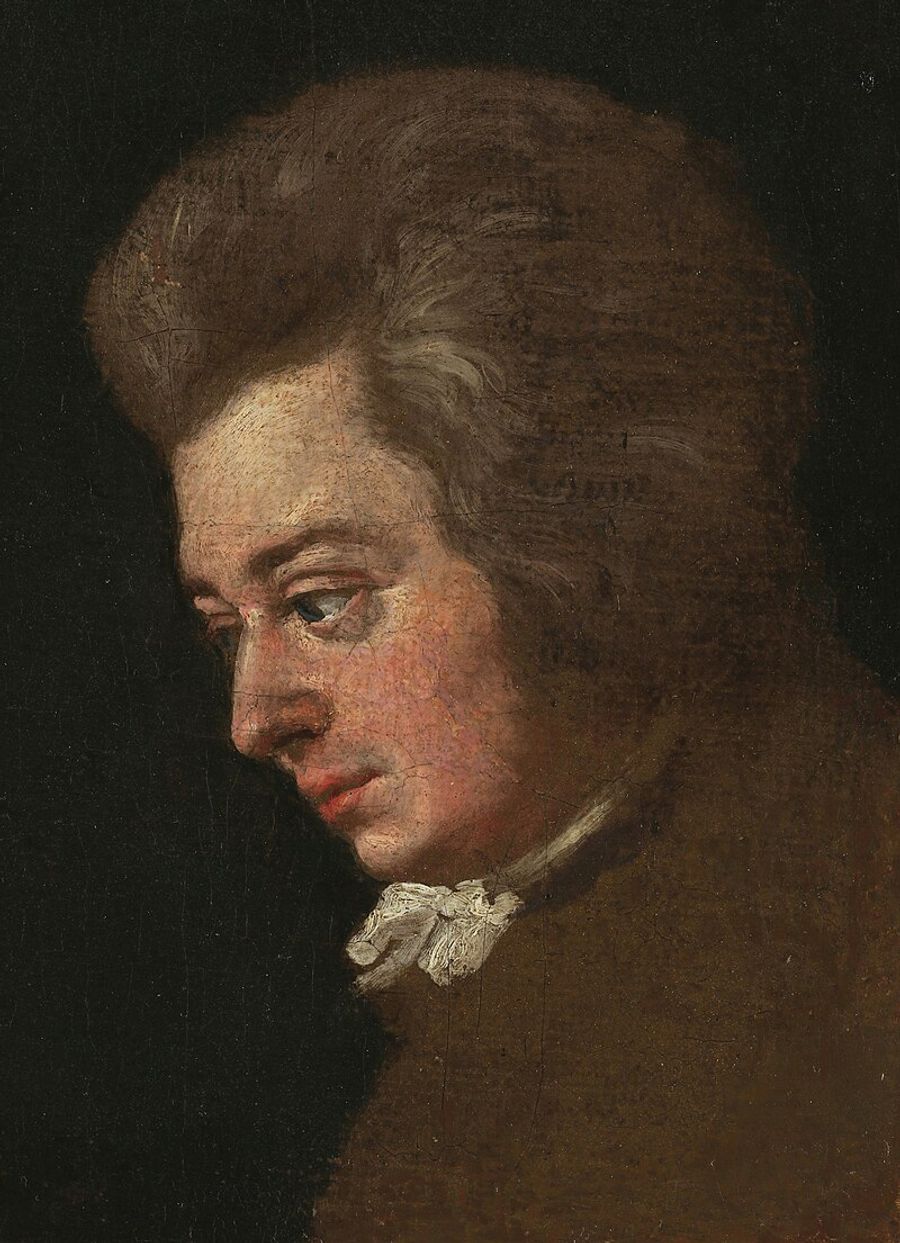
Mozart’s Funeral March for Piano in C minor (K. 453a)—often transmitted under the title Kleiner Trauermarsch (“Little Funeral March”)—is a concise, dark-hued character piece from his Vienna years, traditionally dated to 1784.[1] Though small in scale, it shows Mozart’s gift for giving ceremonial genres real expressive weight, even when the occasion behind them remains tantalizingly obscure.[2]
Background and Context
In 1784—Mozart’s first full burst of success as a freelance musician in Vienna—large public forms (especially the piano concerto) dominated his output, yet he also produced a stream of shorter keyboard pieces that circulated privately among pupils and friends.[1] K. 453a belongs to that intimate world. Its very title invites a double reading: the march is unmistakably cast in a funèbre style, yet it is also linked in later transmission with the fanciful phrase “Marche funebre del Sig.r Maestro Contrapunto,” which hints at satire—mourning not a real person, but an idea (the pedantic “Mr. Counterpoint”) or a musical type.[3]
Whatever the private stimulus, the key of C minor matters. In Mozart’s mature instrumental music, C minor is consistently associated with heightened rhetorical gravity—music that speaks in public gestures, sharp contrasts, and an almost theatrical sense of conflict. In that light, K. 453a deserves attention not as a salon trifle, but as a miniature study in the expressive vocabulary that also animates Mozart’s more famous C-minor works.
Composition
The work is catalogued as Marche funèbre in C minor, K. 453a, and is traditionally dated to Vienna, 1784—when Mozart was twenty-eight.[1][4] Modern commentary connects the piece with Mozart’s circle of pupils, and at least one account places it in the notebook of Barbara Ployer, one of the best-known Viennese students associated with him.[2][3] (Ployer is also closely linked with Mozart’s Piano Concerto No. 17 in G major, K. 453—a proximity in Köchel numbering that has occasionally led to confusion, even though the march is a separate, standalone piece.)
A striking feature of K. 453a’s later history is the fragility of its sources. Reports in the reference tradition note the loss of a key manuscript source during the final months of World War II, a reminder that some of Mozart’s “minor” keyboard works survive by a thinner documentary thread than the concertos and symphonies.[5]
Form and Musical Character
K. 453a is a short, self-contained piano march: music built for measured pacing, clear phrase structure, and a steady tread. Even without the apparatus of an orchestra (no drums, no brass), Mozart evokes the public ritual of a funeral procession through the simplest means—regular stepwise rhythm, chordal writing that suggests a massed sonority, and a firm harmonic profile that keeps returning the ear to C minor.[4]
What makes the piece distinctive within its genre is the tension between stylization and expression. A “funeral march” can easily become mere convention: the composer ticks off the expected gestures and moves on. Mozart, by contrast, gives the conventions a kind of dramatic timing—cadences that seem to arrive with a resigned heaviness, and turns of harmony that briefly darken the path before the march regains its composure. Listeners familiar with Mozart’s operatic writing may hear the same instinct for pacing a scene: a few bars can suggest a whole ceremony.
The subtitle associated with “Maestro Contrapunto” further sharpens the character. If the march is indeed a mild parody (a mock-elegy for academic counterpoint), then Mozart’s seriousness becomes part of the joke: he writes funeral music that is too good for its target. If, on the other hand, the title is an aftergrowth of transmission rather than Mozart’s own, the piece still reads as an affectionate Viennese vignette—ceremonial, compact, and memorably “in character.”[3]
Reception and Legacy
K. 453a has never entered the mainstream piano repertory in the way Mozart’s sonatas or the great variation sets have, and it is rarely programmed as a standalone concert item. Yet it persists in editions and recordings precisely because it fills a niche Mozart otherwise touches only intermittently: the miniature ceremonial piece—music that compresses public rhetoric into a page or two.[4]
For performers, the march offers a compact exercise in classical style: voicing chordal textures, maintaining a dignified pulse, and shaping phrases so that repetition feels like ritual rather than routine. For listeners, it provides an illuminating side-window onto Mozart’s Vienna at age twenty-eight—a year of brilliant public triumphs, but also of private teaching, domestic music-making, and quick, pointed compositions that could carry wit and gravity at once.[1]
Sheet Music
Download and print sheet music for Funeral March for Piano in C minor, K. 453a (1784) from Virtual Sheet Music®.
Sources
[1] Mozarteum Köchel Catalogue entry for KV 453a (work data, key, and overview context of Mozart’s keyboard pieces).
[2] Wikipedia: “Kleiner Trauermarsch, K. 453a” (general description and transmission notes, including association with a student notebook).
[3] Brilliant Classics “Mozart Complete Edition” liner-notes PDF (commentary mentioning Mozart copying the little march into Barbara Ployer’s music-book; transmission of the ‘Maestro Contrapunto’ title).
[4] Bärenreiter preface PDF (editorial note on traditional dating ‘Vienna, 1784’ and contextual remarks on Mozart’s Viennese piano works).
[5] French Wikipedia: “Petite marche funèbre en do mineur (Mozart)” (reference-tradition note on loss of an autograph/manuscript source during WWII).