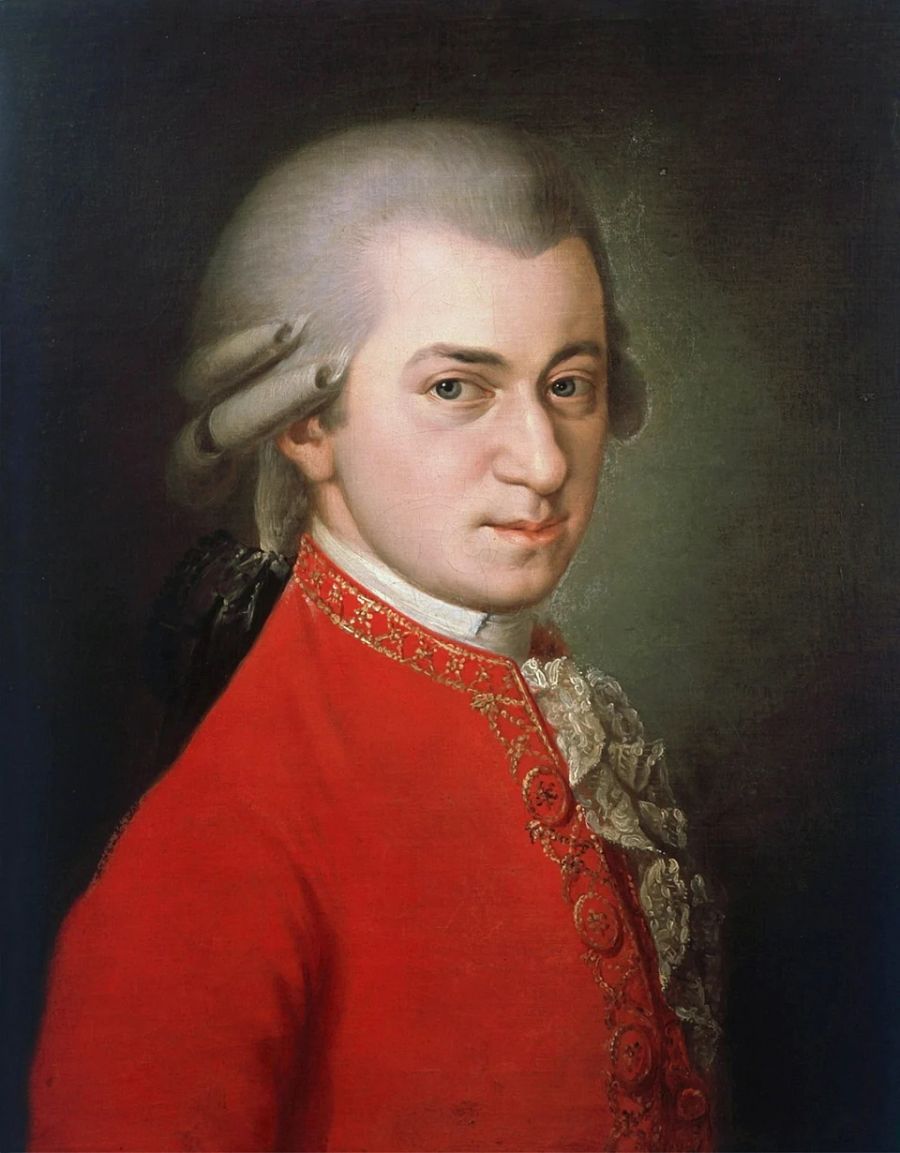
- Köchel Number
- K9 453 | K6 453
- Genre
- Concertos
- Form
- Piano Concertos
- Key
- G Major
- Date
- 12 April 1784
- Place
- Vienna
- Age
- 28
Mozart’s Piano Concerto No. 17 in G major, K. 453, nicknamed the “Second Ployer,” was written for his pupil Barbara (Babette) Ployer. This article discusses the uncertain early performances, the orchestration, and the three movements’ distinctive wind writing and variation finale.
Historical and Personal Context
In 1784 Vienna, Mozart was at the height of his powers as a freelance composer and pianist. He had moved from Salzburg to Vienna in 1781 after leaving his aristocratic post, determined to make a living on his own terms. This was the Enlightenment era under Emperor Joseph II, when public concerts and musical patronage flourished. Without a salaried appointment, Mozart relied on five income streams – patronage, opera commissions, publications, teaching, and concerts – and of these, performing his own concertos was the most lucrative and beneficial[2]. During Lent of 1784, he mounted a remarkable subscription series of concerts, giving around 22 concerts in just over a month (late February to early April) at venues ranging from noble salons to public theaters[3]. These concerts allowed Mozart to showcase himself as both composer and pianist to Vienna’s aristocracy, gaining him fame, pupils, and much-needed income[2][4].
Amid this bustling schedule, Mozart was composing a string of new piano concertos to meet demand. Piano Concerto No. 17 in G major, K. 453 was completed on April 12, 1784, during one of the most fertile periods of his career[3]. Unlike some concertos he wrote for his own concerts, this one was intended for a favored pupil: Barbara (Babette) Ployer, the talented daughter of a Salzburg official living in Vienna[5]. Mozart described his piano concertos as balanced “between being too difficult or too light – truly sparkling and pleasant to the ear” such that connoisseurs could admire them while casual listeners still found joy[6]. He tailored K.453 to be musically rich yet accessible, perfectly suited to demonstrate both his pupil’s ability and his own artistry.
Composition and Premiere
Mozart’s manuscript of the concerto notes that it was written expressly for Barbara Ployer[5]. Ployer was one of Mozart’s star students, and he prepared this concerto for her to perform at a private concert hosted by her family. The exact premiere is not fully certain – scholars propose two possibilities. One account holds that Ployer debuted the concerto on June 13, 1784 at her uncle’s house, with Mozart present as proud mentor[7]. Mozart even invited the famed Italian composer Giovanni Paisiello as a special guest to hear Ployer play his new work[8]. The evening was a grand musical salon: Ployer played the G-major Concerto to great acclaim, and afterward she joined Mozart in performing his recent Quintet for Piano and Winds in E♭, K.452, and a duet with him in the Sonata for Two Pianos, K.448[8]. Contemporary reports note that the gathering gave the concerto a tremendous reception, delighting the assembled Viennese connoisseurs[9].
Another view is that Mozart himself might have introduced the concerto a bit earlier. Musicologist Michael Lorenz argues that Mozart likely performed K.453 in a concert on April 29, 1784 (at the Kärntnertor Theater) rather than waiting two months[10]. This was a concert where Mozart played alongside violinist Regina Strinasacchi, and it would make sense for him to premiere his new concerto there. In either case, K.453 was certainly heard in Vienna’s spring of 1784, soon after its completion. Notably, this concerto became one of only six Mozart piano concertos to be published during his lifetime, indicating its early popularity[9].
Below is a concert recording of Wolfgang Amadeus Mozart’s Piano Concerto No. 17 in G major, K. 453, performed by Martin Helmchen together with the NDR Radiophilharmonie. The performance is led by the orchestra’s chief conductor, Andrew Manze:
Instrumentation and Orchestration
Mozart scored the concerto for a solo fortepiano and a modest classical orchestra. The full instrumentation includes:
Woodwinds: 1 flute, 2 oboes, 2 bassoons
Brass: 2 horns (in G, with horns re-tuned in C for the second movement)
Strings: violins, violas, cellos, and double basses (in their customary roles)
No clarinets, trumpets or timpani are used, keeping with the typical Viennese orchestra of the time[11][12]. A notable feature of K.453’s orchestration is the prominent, independent writing for the woodwinds. Mozart takes full advantage of Vienna’s excellent wind players – the flute, oboes, and bassoons often carry important melodic material rather than acting as mere background coloring[13]. This was unusual in Mozart’s earlier concertos written in Salzburg, where weaker wind sections meant they played only supporting roles[14]. In the G-major Concerto, by contrast, the winds converse with the piano as near-equals, creating a rich chamber music texture within the concerto. The horns provide subtle harmonic support (and a touch of martial color in the first movement’s theme), while the strings and solo piano weave in and out of the musical dialogue.
Musical Structure and Style
Like most of Mozart’s concertos, No.17 is in three movements (fast–slow–fast), each with its own character and innovations[15]:
Allegro (G major) – The concerto opens with a bright, good-natured theme akin to a polite march, setting a cheerful tone[16]. The movement follows sonata form, with the orchestra presenting the amiable main themes before the piano soloist enters. Mozart’s treatment is graceful and “effortless,” moving through several unexpected key changes that add color and interest[13]. The interplay between piano and orchestra is balanced and elegant. Notably, the woodwinds frequently take the lead in introducing or echoing melodies, creating lively conversations. The overall mood is sunny and gallant, though Mozart inserts brief moments of drama in the development section. A cadenza (traditionally improvised by the performer) leads to a satisfying recapitulation and close.
Andante (C major) – The second movement brings a gentle, lyrical contrast. It begins with the strings presenting a serene, singing theme in a lilting 3/4 time. In an unusual structural twist, this tender string melody breaks off after only 20 seconds[17]. At that point, the woodwinds unexpectedly take over: flute, oboe, and bassoon engage in an extended poetic episode, almost as if three opera singers have entered in a trio, with the strings now accompanying them quietly[17]. When the solo piano finally makes its entrance, it restates the opening phrase alone – only to trail off at the same unsure pause as before, heightening the drama[18]. This pattern of start-and-stop “dramatic pauses” recurs four times during the Andante, each time followed by a new and surprising continuation[19]. The influence of Mozart’s operatic writing is evident here: the movement feels like a scene of musical dialogue with pregnant silences and delicate suspense[20]. One of the most striking surprises comes in the last interruption: the piano gently cadences in G major, but the orchestra responds in a distant E♭ major – a jarring harmonic shift that must have made listeners catch their breath[21]. Such expressive dissonances and major–minor shifts give the Andante an emotional depth and an almost romantic tension ahead of its time[16]. Yet overall the atmosphere remains one of intimate, lyrical beauty, showcasing Mozart’s uncanny ability to speak with simplicity and profundity at once.
Allegretto – Presto (G major) – Instead of the typical rondo finale, Mozart offers a theme and variations for the third movement[22]. The movement opens with a graceful, folk-like theme stated by the piano – a tune so simple and charming that it invites playful variation. Indeed, Mozart subjects this melody to five variations, each shifting the texture and mood. Some variations spotlight the piano’s virtuosity with fast passagework, while others give witty dialogues to the wind instruments, keeping the orchestral fabric lively. The spirit of this finale is often compared to comic opera – it abounds in playful wit, musical jokes, and lighthearted twists[16]. After the five variations, Mozart pauses and seemingly starts a new idea: a sudden “Presto” coda erupts, at first sounding like an entirely new movement[22]. This Presto section soon weaves fragments of the main theme back in, as if improvising a little fantasy on it. The effect is that of a grand musical joke – Mozart teases the listener with a false ending and a burst of startling energy before the piece races to its true conclusion.
A famous anecdote is attached to the genial theme of the finale. In May 1784, shortly after writing this concerto, Mozart bought a pet starling and noted that the bird could sing a near-perfect imitation of the concerto’s tune (albeit inserting a funny wrong note)[23]. It appears Mozart either taught the starling to whistle the melody or was charmed to find it already mimicking it. This musical pet shared Mozart’s life for three years and even inspired a short poem Mozart wrote when the bird died. The story of Mozart’s starling has become lore, underlining the theme’s catchy simplicity – catchy enough for a starling to learn![23]. It’s a delightful footnote to this movement’s character: the finale truly sings, chirps, and sparkles with Mozart’s playful genius.
Reception and Legacy
Mozart’s contemporaries immediately appreciated the Piano Concerto No.17. At the private debut in 1784, Ployer’s performance was met with great enthusiasm, and the concerto was soon heard in other concerts across Vienna[9]. Its warm reception is evident from the fact that it was one of just six piano concertos Mozart saw published in print during his lifetime[9], suggesting strong demand among aficionados and amateur players alike. Reviews from the time (where documented) praised its tasteful blend of brilliance and elegance, and Mozart’s own satisfaction with the piece can be inferred from his letter remarking on the universal appeal of his concertos[6].
Over time, K.453 has come to be regarded as a gem of Mozart’s Viennese concertos. nineteenth-century audiences, enamored with flashier Romantic works, did not always give Mozart’s lighter concertos their due, but the G-major Concerto quietly endured as a favorite of those who knew it. In the 20th and 21st centuries, as Mozart’s entire concerto output returned to prominence, No.17 has been valued for its subtlety and charm. Musicians often highlight its sensitive, witty character – it is a work full of nuanced delights rather than grandiose effects[9]. Notably, Mozart’s brilliant series of 1784 concertos (including K.453) helped elevate the piano concerto genre itself. He transformed it from a shallow vehicle for virtuosity into a sophisticated form on par with the symphony, infused with symphonic breadth and operatic interplay[24][25]. Later composers, from Beethoven onward, built on the model Mozart provided, inspired by the way he balanced soloist and orchestra in a dramatic yet harmonious partnership[25].
Today, Piano Concerto No.17 in G major remains a staple of the repertoire – admired by scholars and beloved by audiences. Its legacy is one of classical elegance combined with quiet innovation. Whether it’s the imaginative touches of the Andante, the sparkling humor of the finale, or the beautiful wind writing throughout, K.453 exemplifies Mozart’s artistry at its finest. Performers continue to find fresh joy in its pages, ensuring that this concerto’s “sparkling and pleasant” qualities endure, enchanting new listeners just as it charmed that Viennese gathering in 1784.[6][9]
Sources
Sources
Mozart’s autograph thematic catalog and letters; program notes from the LA Philharmonic (Howard Posner)[26][22]; the Hungarian National Philharmonic’s notes[27][7]; and scholarly summaries (e.g. A. Hutchings, Companion to Mozart’s Piano Concertos). These sources provide the factual and interpretive details summarized above.
[1] File:Mozart (unfinished) by Lange 1782.jpg - Wikimedia Commons
https://commons.wikimedia.org/wiki/File:Mozart_(unfinished)_by_Lange_1782.jpg
[2] [3] [4] [6] [7] [8] [9] [16] [24] [25] [27] Concerto for Piano and Orchestra in G Major K. 453 – Filharmonikusok
https://www.filharmonikusok.hu/en/muvek/g-dur-zongoraverseny-k-453/
[5] [12] [13] [14] [17] [18] [19] [20] [21] [22] [23] [26] Piano Concerto No. 17, Wolfgang Amadeus Mozart
https://www.laphil.com/musicdb/pieces/2740/piano-concerto-no-17
[10] [11] [15] Piano Concerto No. 17 (Mozart) - Wikipedia
https://en.wikipedia.org/wiki/Piano_Concerto_No._17_(Mozart)