- Köchel Number
- K9 45 | K6 45
- Genre
- Orchestral Music
- Form
- Symphonies
- Key
- D Major
- Date
- 16 January 1768
- Place
- Vienna
- Age
- 12
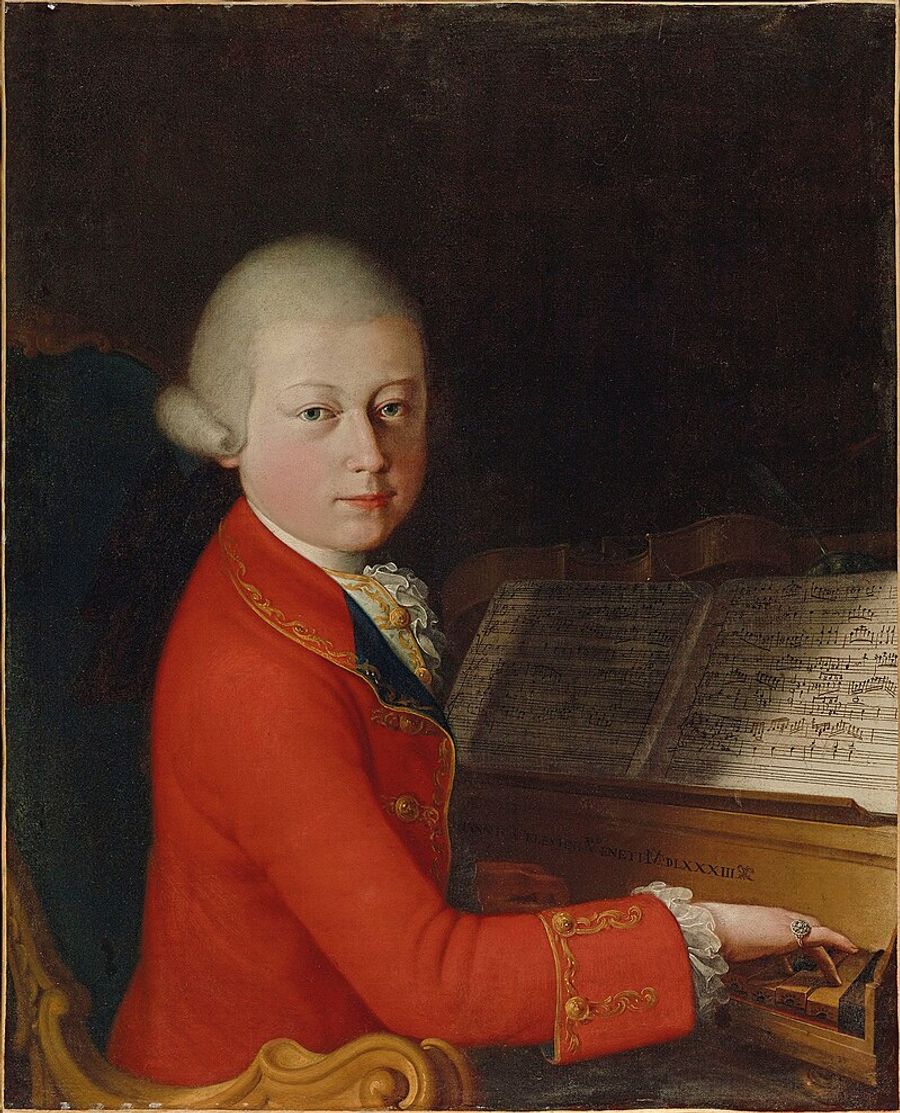
Mozart’s Symphony No. 7 in D major (K. 45) was completed in Vienna in January 1768, when the composer was just twelve. Compact, festive, and alert to Viennese taste for four-movement symphonies, it shows a boy-composer already thinking theatrically—so much so that Mozart later refashioned parts of it for the stage.
Background and Context
The winter of 1767–68 found Wolfgang Amadeus Mozart (1756–1791) and his family in Vienna, a city whose musical life offered both opportunity and pressure for the celebrated child prodigy. Vienna also meant stylistic cross-currents: Italianate overture-brilliance, emerging classical symphonic conventions, and a local preference (in concert settings) for four-movement plans that included a minuet.
In this setting Mozart composed Symphony No. 7 in D major, K. 45, one of the so-called “juvenile” symphonies from his pre-Salzburg-adulthood years. These early works are often treated as apprenticeships; yet K. 45 deserves attention precisely because it is more than a generic exercise. It demonstrates (1) a clear sense of public, ceremonial tone in D major, and (2) an instinct for reusability: the piece would later be adapted—trimmed and reshaped—into an overture-like version connected with Mozart’s early opera La finta semplice (K. 51/46a).[1]
Composition and Premiere
The work is generally dated to January 1768 in Vienna.[2] (IMSLP gives a specific date: 16 January 1768.)[1] Clear documentation of a public premiere is lacking, a common situation for Mozart’s early symphonies, many of which circulated privately or in courtly/ambassadorial contexts rather than through formal “subscription concert” systems.[2]
One plausible early occasion is a private concert at the Vienna residence of Prince Dmitry Golitsyn (Galitzin), the Russian ambassador, in late March 1768—a scenario proposed in modern scholarship and repeated in reference accounts.[2] Even if the exact first performance remains uncertain, K. 45 fits neatly into what Vienna could use: a concise, brilliant symphony in a celebratory key, with a minuet for polite society and a finale built for quick applause.
Instrumentation
Mozart scores K. 45 for an early-classical orchestra with festive color.
- Winds: 2 oboes; bassoon (often understood as reinforcing the bass line)
- Brass: 2 horns; 2 trumpets
- Percussion: timpani
- Strings: violins I & II, viola, cello, double bass
- Continuo: customary in period practice and indicated in modern descriptions of the original version[2]
A practical nuance worth noting: some sources point out that trumpets and timpani are used only in the later movements (notably the minuet and finale), heightening the sense of arrival and ceremonial finish.[1]
Form and Musical Character
K. 45 follows the four-movement Viennese pattern, but within a tight span (roughly ten minutes in many performances).[1] Its distinctiveness lies less in harmonic daring than in theatrical pacing: quick contrasts, clear cadential punctuation, and a feeling that each movement has a sharply defined social function.
I. Molto allegro (D major)
The opening announces itself with confident, almost “overture-like” energy—brisk unisons, bright D-major rhetoric, and phrasing designed for immediate comprehension. Even at twelve, Mozart shows an emerging command of sonata-allegro thinking (exposition–development–recapitulation) in miniature: themes are short, the argument is direct, and contrast is achieved through texture and register as much as through elaborate modulation.[2]
II. Andante (G major)
The slow movement shifts to the subdominant (G major), a standard classical relaxation of tension. Its charm lies in economical means: a singing line over a lightly articulated accompaniment, more like an intimate aria without words than a “grand” slow movement. In the context of Mozart’s early symphonies, this kind of cantabile central panel is often where his melodic gift most plainly shows through the formula.[2]
III. Menuetto e Trio (D major)
The minuet situates the symphony in a recognizably Viennese social world. It is sturdy rather than subtle, but its very straightforwardness tells us something about function: this music could sit comfortably between courtly dancing and concert listening. The movement is also historically revealing because it was the part Mozart could later omit when turning the symphony into a more overture-like piece—an implicit reminder that the minuet, however expected in Viennese concert symphonies, was also the most “removable” when theatrical utility called.[1]
IV. Molto allegro (D major)
The finale is a quick, goal-directed close in the bright home key. It crowns the work’s festive profile—especially when trumpets and timpani are brought in—making K. 45 sound larger than its brief duration suggests.[1]
Reception and Legacy
K. 45 is not a “famous” Mozart symphony, and even its numbering can be confusing: some cataloging and edition traditions assign numbers differently across the early corpus, since several youthful symphonies have uncertain provenance, alternate versions, or complicated publication histories.[2]
Its legacy is therefore less about canonical concert presence than about what it reveals of Mozart’s development. The symphony demonstrates a twelve-year-old absorbing Viennese expectations—four movements, a minuet, a bright D-major ceremonial tone—while also writing with a practical theatrical instinct that allowed later adaptation for La finta semplice.[1] Heard on its own terms, K. 45 rewards listeners who enjoy the “workshop” of classical style: the young Mozart’s gift for momentum, clear-cut contrast, and melodic poise already points toward the mature symphonist, even if the scale remains intentionally modest.
Sources
[1] IMSLP — score information, movement list, dating (16 Jan 1768), and note on later revision/omitted minuet for overture use in La finta semplice
[2] Wikipedia — overview, Vienna January 1768 completion, probable private early performance, original instrumentation and four-movement plan; notes on overture version and numbering issues