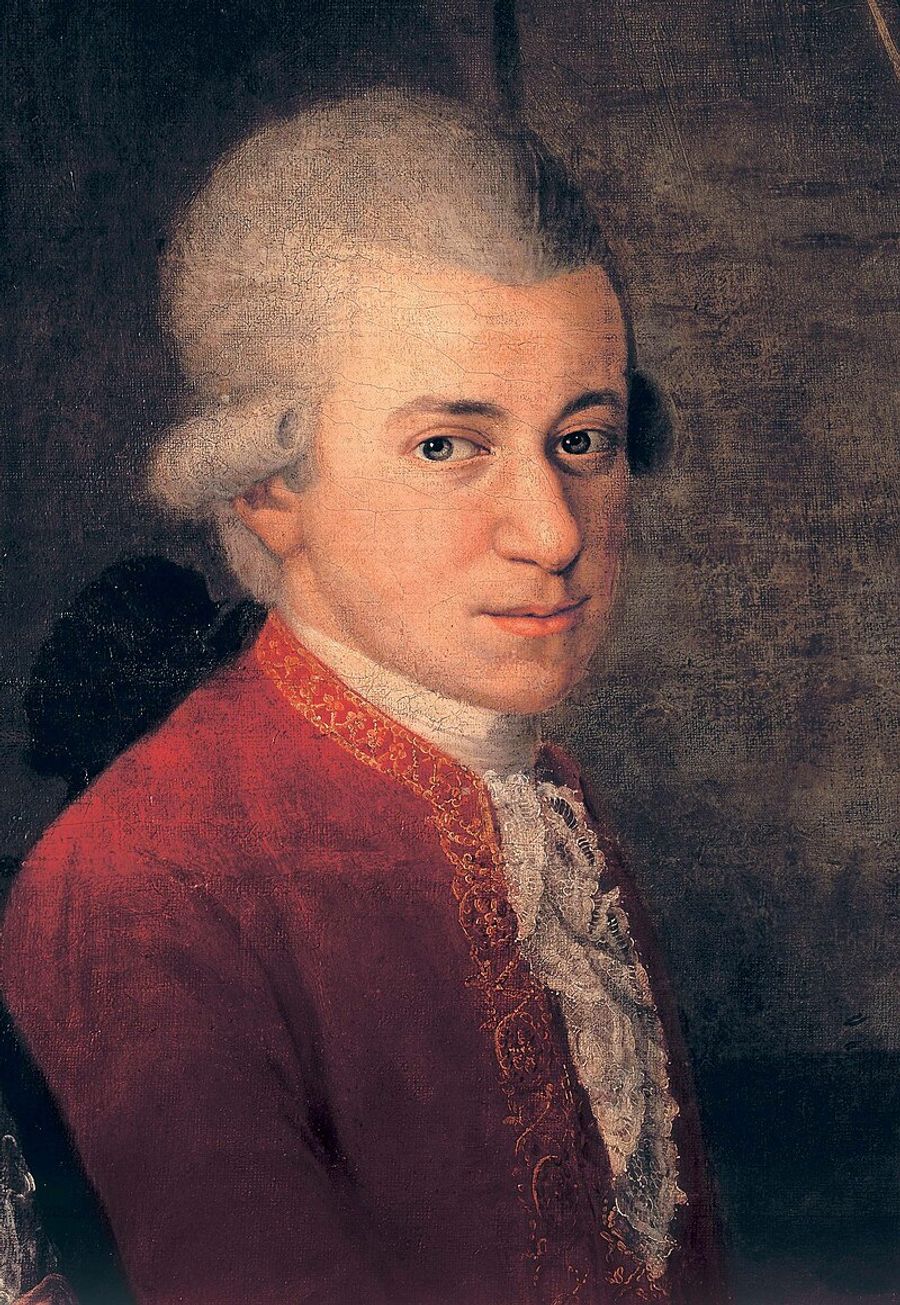
- Köchel Number
- K9 379 | K6 373a
- Genre
- Chamber Music
- Form
- Violin Sonatas & Variations
- Key
- G Major
- Date
- April 1781
- Place
- Vienna
- Age
- 25
Mozart’s Violin Sonata No. 27 in G major (K. 379/373a) was composed in Vienna in 1781, when the 25-year-old composer was newly embarked on his career as a freelance musician. Cast in just two movements—an intense Adagio–Allegro followed by a spacious theme and variations—the work is a compact but remarkably dramatic essay in the mature Viennese “keyboard-and-violin” duo.
Background and Context
In March 1781 Wolfgang Amadeus Mozart (1756–1791) arrived in Vienna as part of Archbishop Colloredo’s Salzburg retinue—a situation that quickly became unbearable, but which also placed him in Europe’s most competitive musical marketplace.[1] In this moment of transition, Mozart needed “calling cards”: works that could be sold to publishers, performed in aristocratic salons, and used to advertise his skills as a keyboard player.
The violin-and-keyboard sonata was ideal for this purpose. In Mozart’s hands, it is seldom a “violin sonata” in the later Romantic sense; rather, it belongs to the late-18th-century genre often marketed as a keyboard sonata with violin accompaniment—yet with an increasingly conversational, chamber-like partnership.[2] K. 379 stands out within the 1781 Viennese set for the seriousness of its opening movement and for its unusually elaborate second movement: a full set of variations rather than a conventional fast finale.[3]
Composition and Dedication
K. 379 was composed in Vienna in 1781 and belongs to the group of six sonatas that Artaria published as Mozart’s Op. 2 (K. 296 and K. 376–380).[4] Mozart’s letters and later editorial scholarship connect the work to a specific, rather pressured occasion: a musical evening on 8 April 1781 in the house of the Teutonic Order, where Mozart performed with the Salzburg court violinist Antonio Brunetti.[1] Mozart famously reported to his father that he had composed the sonata the previous night “between eleven and twelve,” writing out only Brunetti’s violin part while keeping his own keyboard part in memory for the performance.[1]
In a broader sense, the publication context matters as much as the anecdote. Artaria advertised the Op. 2 set in Vienna on 8 December 1781, and contemporary commentary already recognized that these were not merely keyboard sonatas with optional violin, but works in which both players participate materially.[4]
Instrumentation
- Keyboard: fortepiano (or modern piano)
- Strings: violin
Form and Musical Character
Mozart’s Sonata in G major, K. 379/373a is in two large panels, each with its own expressive “world.”[3]
I. Adagio (G major) – Allegro (G minor)
The opening Adagio immediately signals that this is not lightweight domestic music. The texture is rhetorical and spacious, with the violin entering as a singing partner rather than as decoration; the harmony lingers and questions, as though the piece were beginning mid-thought. When the Allegro arrives, the turn to G minor sharpens the emotional profile: the movement becomes taut and argumentative, with quick exchanges and a more urgent rhythmic gait.
A listener accustomed to Mozart’s three-movement violin sonatas may be surprised by the scale and weight concentrated into this single movement: slow introduction and fast movement are fused into a drama that feels almost symphonic in ambition, yet remains intimate—two players in close dialogue.
II. Theme: Andantino cantabile (G major), with variations
Instead of a finale, Mozart offers a theme and variations—an arena in which he can display invention, register contrast, and textural wit without leaving the gracious orbit of G major for long.[3] Especially striking is Variation 1, scored for keyboard alone, a reminder that in this repertory Mozart often still places the keyboard at the center of gravity even while granting the violin real independence.[3] Later, a darker-colored minor-mode variation deepens the expressive range, and the closing returns to the theme with a sense of rounded completeness.
In miniature, this variation movement sums up what makes K. 379 distinctive: Mozart treats a “salon” genre with a seriousness of craft—creating not merely decorative change, but a sequence of character pieces that alternate intimacy, brilliance, and shadow.
Reception and Legacy
K. 379 entered the world not as an isolated masterpiece but as part of a strategically published set. Artaria’s Op. 2 sonatas circulated quickly beyond Vienna; by spring 1782 they were being reviewed and sold as far away as the Hamburg/Altona area, where critics emphasized the novelty of the duo partnership.[4] Later evidence shows that the Op. 2 sonatas were reprinted multiple times and remained widely available in print during Mozart’s lifetime.[5]
Why does K. 379 deserve special attention today? Precisely because it compresses two apparently opposite impulses—public virtuosity and private expressivity—into a tightly argued form. It belongs to Mozart’s “mature Viennese” chamber output in the sense that it is already aimed at Vienna’s mixed economy of public concerts, aristocratic music-making, and commercial publication; yet its emotional weather is unusually changeable and, at moments, searching.[1] For performers, it offers a particularly rewarding challenge: to balance the keyboard’s structural authority with the violin’s lyrical urgency, and to make the variation set feel like a continuous narrative rather than a sequence of ornaments.
Sources
[1] Neue Mozart-Ausgabe (Digital Mozart Edition), foreword and editorial commentary for Sonatas and Variations for Keyboard & Violin (includes Brunetti/8 April 1781 context and quoted letter passage).
[2] Mozarteum Köchel-Verzeichnis entry discussing the keyboard-centered nature of Mozart’s violin sonatas and related violin-and-keyboard variations.
[3] Work overview and movement/variation layout for *Violin Sonata No. 27 in G major, K. 379/373a*.
[4] MozartDocuments.org commentary on Artaria’s Op. 2 publication (advertisement date 8 Dec 1781; early reception; framing of violin/keyboard partnership).
[5] MozartDocuments.org commentary noting Op. 2 (K. 296 and K. 376–380) as widely available and reprinted by 1789.