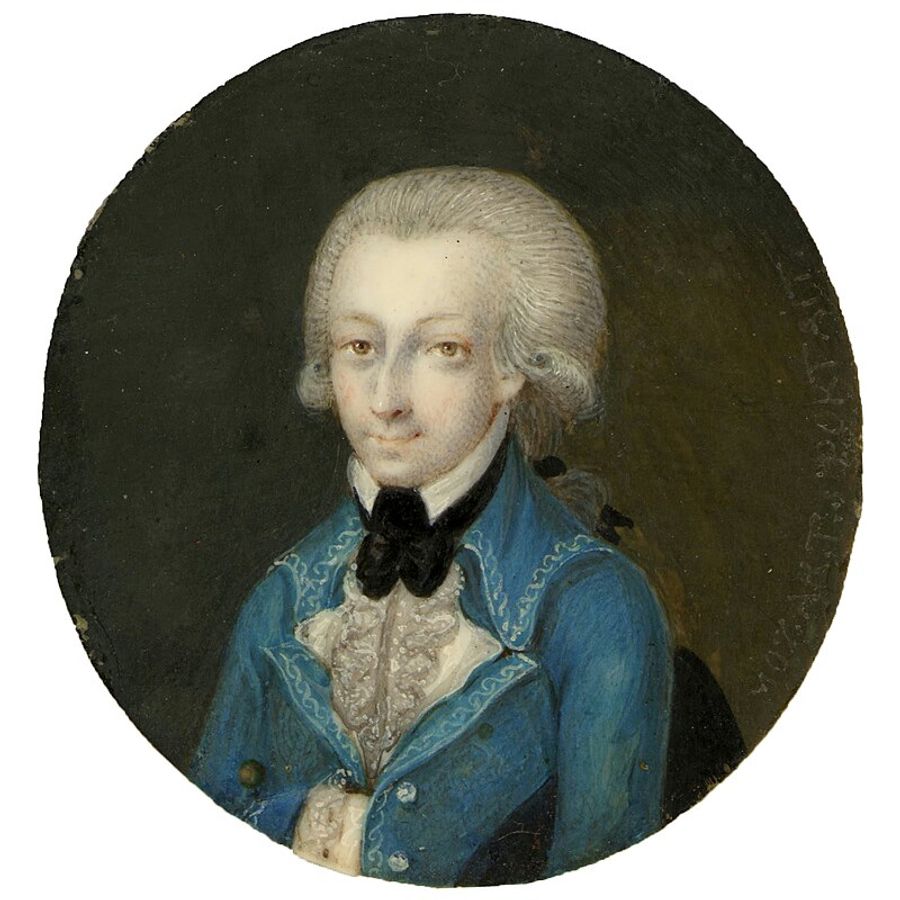
- Köchel Number
- K9 296 | K6 296
- Genre
- Chamber Music
- Form
- Violin Sonatas & Variations
- Key
- C Major
- Date
- 11 March 1778
- Place
- Mannheim
- Age
- 22
Mozart’s Violin Sonata No. 17 in C major, K. 296 (1778) was completed in Mannheim during the composer’s decisive journey away from Salzburg—music written for the salon, yet already thinking with symphonic breadth. Often described as a “keyboard sonata with violin,” it nonetheless makes a persuasive case for equality between the partners, beginning with a striking unison gesture and ending in a rondo whose wit depends on genuine dialogue.
Background and Context
In 1777–78 Wolfgang Amadeus Mozart (1756–1791) travelled with his mother, Anna Maria, in search of a secure post beyond Salzburg. Mannheim—home to the famed court orchestra and a city synonymous with orchestral refinement—offered him both models of modern style and an audience for fashionable chamber music. The Sonata for Keyboard and Violin in C major, K. 296 belongs to this Mannheim period and was completed on 11 March 1778, only days before the Mozarts continued on to Paris [1].
Mozart’s violin sonatas of the 1770s sit at an instructive historical crossroads. In many domestic settings the keyboard player led, and the printed title pages often reflect that hierarchy (Sonata for clavier with the accompaniment of a violin). Yet K. 296 stands out among the Mannheim sonatas for how insistently it tests the genre’s assumptions: the violin is not merely a doubling instrument, but a participant that can initiate, contradict, and complete musical arguments. That subtle rebalancing—achieved without overt virtuoso display—is one reason the piece deserves more attention than its modest concert frequency might suggest.
Composition and Dedication
K. 296 was written in Mannheim in 1778 (Mozart was 22), and Mozart’s autograph bears a dedication to “Therese,” generally identified as Therese (Pierron) Serrarius, connected with the household in which Mozart lodged [2]. The work was later issued in print in 1781 as part of Mozart’s Opus 2 set of six violin sonatas (K. 296 and K. 376–380) [1]. This publication history matters: it places a Mannheim product into the early-Vienna marketplace, where Mozart—now newly freelance—was learning how repertoire, dedication, and print could be leveraged for reputation and income.
In practical terms the sonata is scored for keyboard (fortepiano) and violin [3]. The genre’s “accompanied” label can be misleading here, because Mozart repeatedly gives the violin material that is structurally necessary rather than decorative.
Form and Musical Character
K. 296 is a three-movement sonata:
- I. Allegro vivace (C major) [1]
- II. Andante sostenuto (F major) [1]
- III. Rondeau: Allegro (C major) [1]
I. Allegro vivace
The opening is immediately distinctive: a bold, overture-like unison statement presents violin and right hand of the keyboard as a single rhetorical actor—an arresting way to announce partnership in a genre that often begins with keyboard alone. From there, Mozart’s texture becomes more conversational, with short motives passed between the players and with the violin frequently serving as a commentator rather than a mere reinforcement.
At the level of form, the movement behaves like a confident sonata-allegro design (exposition, development, recapitulation), but what listeners often notice first is Mozart’s control of register and brightness: C major is treated not as bland “neutrality,” but as a brilliant public key capable of ceremonial grandeur one moment and quicksilver intimacy the next.
II. Andante sostenuto
The slow movement in F major shifts the center of gravity to cantabile line and harmonic poise. The violin’s role is especially telling: it can sing above the keyboard, but it also blends into the keyboard’s texture, creating a chamber-music version of operatic ensemble—two voices that remain distinct even when they seem to breathe together.
III. Rondeau: Allegro
The finale’s rondo refrain has an air of easy sociability, but Mozart’s craft lies in the episodes: contrasting turns of harmony, brief spurts of imitation, and timing that depends on both players’ alertness. In performance, this is where K. 296 most clearly escapes the “keyboard-with-accompaniment” stereotype; the humor and momentum are carried by interplay.
Reception and Legacy
Although K. 296 has never been as ubiquitous as Mozart’s late violin sonatas (such as the expansive Sonata in B♭, K. 454), it has remained firmly within the core repertoire and is widely available in modern editions and in the historical sources preserved and disseminated through scholarly and public archives [3]. Its early publication in Op. 2 also marks it as a work Mozart considered suitable for broad circulation—music aimed at amateurs and connoisseurs alike, but engineered with professional polish.
K. 296’s particular legacy is stylistic: it shows Mozart, at a pivotal age, taking a conventional domestic genre and nudging it toward true duo sonata thinking. The result is a piece whose surface geniality should not disguise its ambition. Heard with attentive ears, it is not simply “pleasant Mannheim Mozart,” but a compact demonstration of how dialogue—real dialogue—can be built into classical form.
Sheet Music
Download and print sheet music for Violin Sonata No. 17 in C major, K. 296 from Virtual Sheet Music®.