- Köchel Number
- K9 35 | K6 35
- Genre
- Sacred Music
- Form
- Oratorios, Sacred Singspiels & Cantatas
- Date
- 1767
- Place
- Salzburg
- Age
- 11
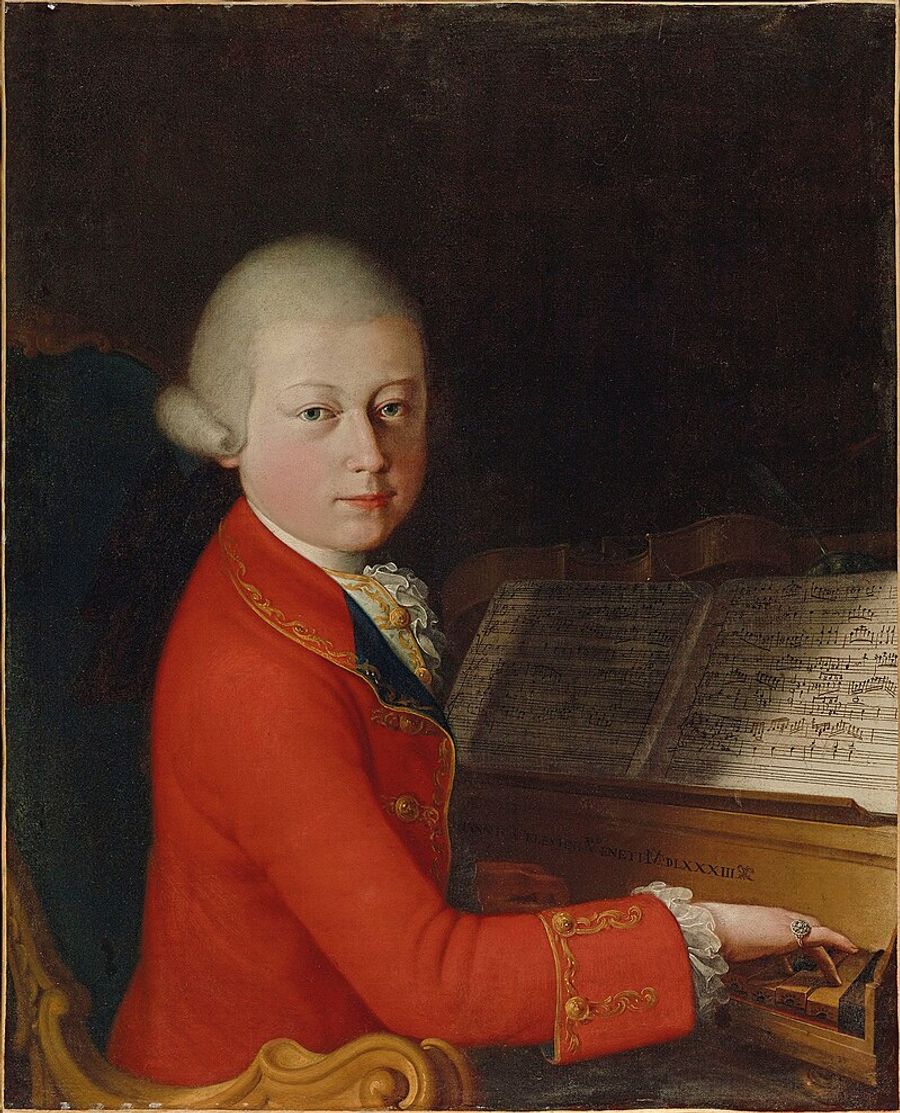
Mozart’s Die Schuldigkeit des ersten Gebots (K. 35) is a sacred musical play (geistliches Singspiel) begun in Salzburg in 1767, when the composer was just 11. Conceived for Lent as an edifying drama for court and school culture, it reveals an early—yet already theatrical—Mozart testing how operatic rhetoric might serve moral allegory.
Mozart's Life at the Time
In 1767, Wolfgang Amadeus Mozart (1756–1791) was back in Salzburg as an 11-year-old who had already absorbed an astonishing range of European styles during his childhood travels. Salzburg’s musical life, shaped by the prince-archbishop’s court, supported a strong tradition of sacred works that borrowed the means of the theatre—arias, recitative, ensembles—without becoming opera in the secular sense. Die Schuldigkeit des ersten Gebots belongs squarely to that world: a Lenten moral drama intended to instruct and move, rather than to entertain for its own sake.[1][2]
The work is sometimes encountered today as a “fragment,” because Mozart composed only Part I of what was originally a three-part project—a common Salzburg practice in which multiple composers contributed separate portions of a single sacred drama.[1] That circumstance can obscure its real interest: within a strictly didactic genre, the young Mozart is already thinking like a dramatist, assigning sharply contrasted musical profiles to allegorical characters.
Composition and Manuscript
The libretto is now attributed to Ignaz Anton von Weiser, a Salzburg civic official and writer; modern documentation (cited in reference literature) supports this attribution.[3][4] The dramatis personae are allegorical: Christgeist (the Spirit of Christianity), Barmherzigkeit (Divine Mercy), Gerechtigkeit (Divine Justice), Weltgeist (Worldliness), and Der Christ (the Christian soul who must choose).[1]
The first performance of Mozart’s part took place in Salzburg on 12 March 1767, in the Knights’ Hall (Rittersaal) of the prince-archbishop’s residence.[5] Modern editions preserve Mozart’s contribution as K. 35, and the work’s transmission has been further supported by scholarly cataloguing and critical editorial work connected to the Neue Mozart-Ausgabe.[6]
Musical Character
What makes Die Schuldigkeit des ersten Gebots worth attention is the way it demonstrates, unusually early, Mozart’s instinct for character through musical language. The conflict is doctrinal (the First Commandment), but the theatre is psychological: persuasion, resistance, seduction, fear, and resolve all receive distinct rhetorical “voices.” In other words, the piece is not merely pious declamation; it is sacred argument staged as drama.
Even without treating the score as an “opera in church clothing,” listeners can hear Mozart experimenting with the building blocks that later energize his mature stage works: pointed contrasts between characters, the capacity of recitative to think aloud, and the aria as a moment of moral self-definition. The allegorical casting intensifies these contrasts—Weltgeist can glitter with worldly charm, while Gerechtigkeit and Barmherzigkeit embody opposing (yet complementary) divine attributes whose musical demeanor must be immediately legible.[1]
Historically, the work also documents a local Salzburg tradition that would soon wane under changing cultural and ecclesiastical priorities. In that sense, K. 35 is doubly valuable: it is early Mozart, and it is a snapshot of a specific institutional genre—Lenten sacred drama—that shaped how a prodigy learned to fuse liturgical purpose with stagecraft.[7]
Sources
[1] Wikipedia overview (genre, characters, Salzburg multi-composer practice, context)
[2] Köchel-Verzeichnis (Internationale Stiftung Mozarteum): work entry for K. 35
[3] IMSLP work page: catalog details and libretto attribution
[4] German Wikipedia: Ignaz Anton von Weiser (biographical context; connection to K. 35)
[5] Forsyths (Urtext edition product page): performance date and venue (12 March 1767, Knights’ Hall, Salzburg)
[6] IMSLP index for the Neue Mozart-Ausgabe (NMA): volume listing including K. 35
[7] Köchel-Verzeichnis contextual note on Salzburg school-drama tradition (mentions K. 35)