- Köchel Number
- K9 33h | K6 33h
- Genre
- Piano Music
- Form
- Piano Pieces
- Date
- 1766
- Place
- Salzburg
- Age
- 10
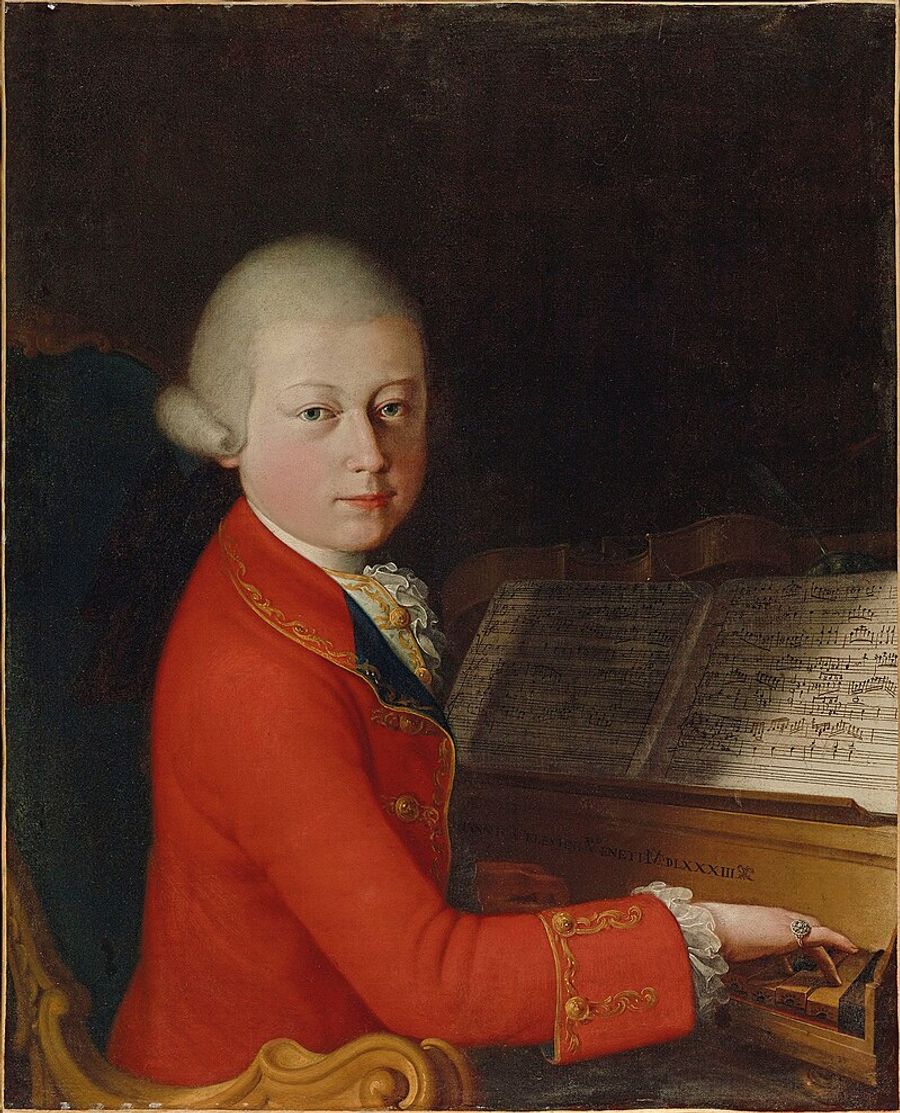
Mozart’s Waldhornstück (K. 33h) is a lost juvenile work, probably dating from 1766 in Salzburg, when he was ten years old [1]. It survives only as a documentary mention rather than as music that can be performed or closely analyzed [2].
Mozart's Life at the Time
In 1766, the ten-year-old Wolfgang Amadeus Mozart was based in Salzburg between major legs of the family’s travels, still composing opportunistically for the people and occasions around him. A later reminiscence by Leopold Mozart—written on 16 February 1778 in a letter to his wife Anna Maria and to Wolfgang—recalls that, “many years earlier,” Wolfgang had made a small piece (Waldhornstückl) for Martin Grassl, a servant in the household of Prince Breuner (dean of Salzburg Cathedral) [2].
Musical Character
No autograph or copy of K. 33h is known to survive, and the letter does not describe its key, length, or formal plan [2]. The title Waldhornstück (literally “hunting-horn piece”) suggests that it was conceived with horn sonority in mind—perhaps a short fanfare-like idea or a simple tune shaped by the natural horn’s harmonic series—yet this remains conjectural without the notes themselves [1]. In that sense, K. 33h is best understood as a glimpse of the young Mozart’s practical, socially embedded music-making in Salzburg: a small, likely functional piece written for a specific local musician rather than for publication or posterity [2].
Sources
[1] Musiikkikirjastot.fi (PDF book excerpt) — notes on K. 33h as a possibly Salzburg 1766 lost work; mentions Leopold’s reference to a “Waldhornstückl.”
[2] Digital Mozart Edition (dme.mozarteum.at) — Leopold Mozart letter, Mannheim, 16 Feb 1778 (English transcription), referencing that Wolfgang wrote a small hunting-horn piece (KV 33h, lost) for Martin Grassl.