- Köchel Number
- K9 33 | K6 33
- Genre
- Sacred Music
- Form
- Masses & Requiem
- Key
- F Major
- Date
- 12 June 1766
- Place
- Paris
- Age
- 10
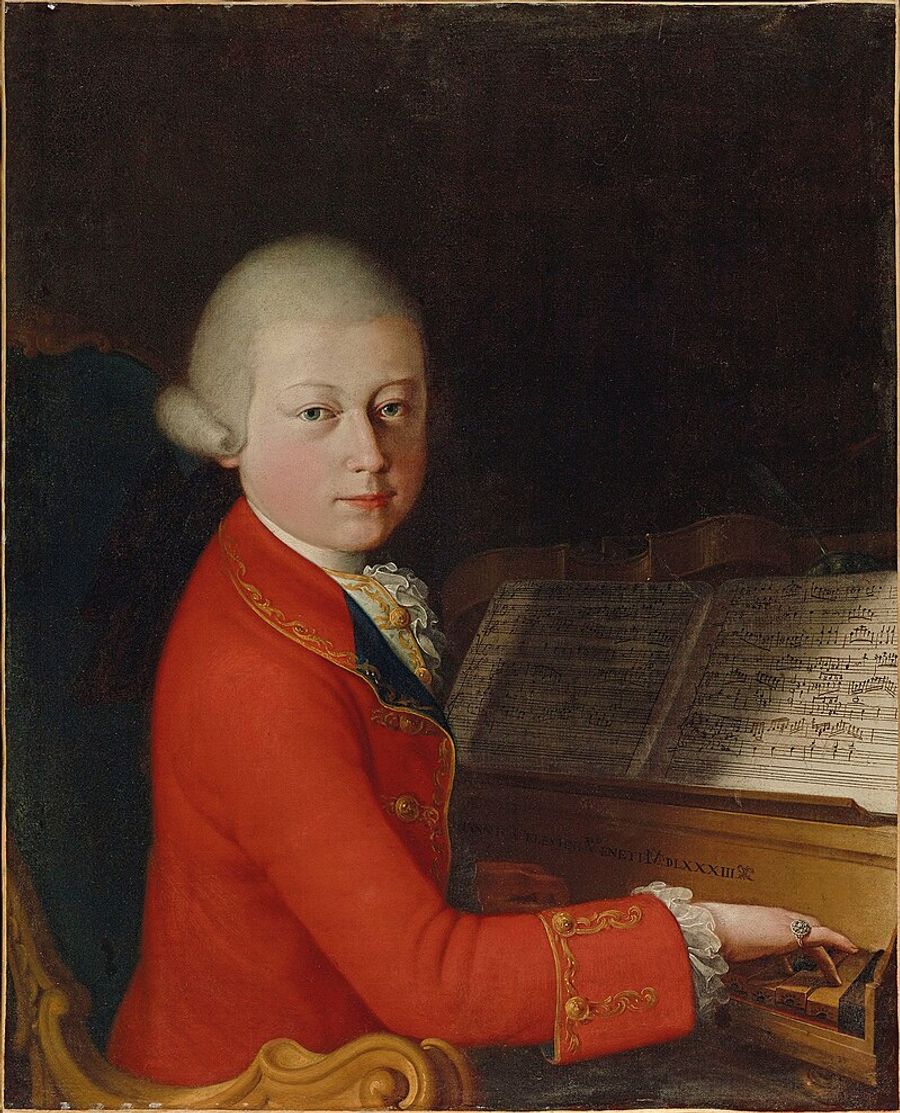
Mozart’s Kyrie in F major (K. 33) is a compact setting of the Mass Ordinary, dated 12 June 1766 and written in Paris when the composer was only ten. Modest in scale yet surprisingly assured, it offers a rare glimpse of Mozart testing church style outside Salzburg—absorbing French tastes while already thinking in clear, strongly projected choral paragraphs.
Mozart’s Life at the Time
In June 1766, Wolfgang Amadeus Mozart (1756–1791) was in the midst of the Mozart family’s long Western European tour, intended—largely through public appearances—to confirm the child’s astonishing gifts to the most influential musical circles of the day. Paris was a particularly strategic destination: it offered not only concert life and aristocratic salons, but also a distinct sacred style (both in sonority and in rhetorical “public” gesture) that differed from the Salzburg sound-world Mozart knew at home.
The Kyrie in F major, K. 33 belongs to this Paris period and is explicitly dated in the autograph “a Paris … 12 Juni … 1766.”[1] As an isolated Kyrie rather than a complete Mass, it also shows how pragmatic juvenile composition could be on tour: a self-contained movement was easier to copy, circulate, demonstrate, and (potentially) insert into local liturgical practice than an entire setting of the Ordinary.
Composition and Manuscript
K. 33 survives as an autograph score and is therefore unusually well anchored for a small-scale juvenile sacred work.[1] The principal performing forces are a four-part chorus (SATB) with strings and continuo (organ), the sort of compact “church orchestra” Mozart could expect to find in many Catholic contexts.[2] The Mozarteum’s Köchel-Verzeichnis entry also preserves the later, more explicit scoring tradition transmitted in manuscript copies (including viola, basses, and organ alongside two violins).[1]
Even this early, the sources hint at family workshop practice: scholarship notes that Leopold Mozart appears to have made editorial interventions in the manuscript, a reminder that the “tour works” were often polished for maximum presentational impact.[3]
Musical Character
Although K. 33 is brief, it is not musically “babyish.” Its appeal lies in how decisively Mozart treats the Kyrie text—short petitions (Kyrie eleison / Christe eleison / Kyrie eleison) articulated in distinct blocks—while maintaining forward drive and choral clarity. The writing tends toward homophonic declamation (text together) enlivened by more contrapuntal moments, so the listener hears both public solemnity and flashes of learned technique—an early foreshadowing of Mozart’s lifelong ease in moving between “church” counterpoint and theatrical immediacy.
One particularly telling trait is the way the strings do more than simply double the choir: the instrumental parts help “light” individual vocal registers, creating an almost coloristic hierarchy within a small ensemble. Contemporary commentary has noted, for instance, how upper strings can reinforce inner voices in ways that sharpen the harmony and make the choral texture speak more vividly.[3]
Why does this little Paris Kyrie deserve attention? Precisely because it sits at a crossroads. It is an early sacred movement written far from Salzburg, but already displays Mozart’s instinct for rhetorical pacing and for making counterpoint serve expression rather than display. Heard alongside the first complete Mass that followed a couple of years later (Mass in G major, K. 49), K. 33 reads like a focused study: not a grand liturgical statement, but a concise, well-made musical calling card—one that shows the ten-year-old composer learning local styles while quietly extending his own.[4]
Sheet Music
Download and print sheet music for Kyrie in F major, K. 33 (“Paris Kyrie”) from Virtual Sheet Music®.
Sources
[1] Mozarteum Köchel-Verzeichnis entry for KV 33, including autograph dating and source listings.
[2] IMSLP work page for Kyrie in F major, K. 33: instrumentation categories and score access.
[3] Wikipedia overview for Kyrie in F major, K. 33: date, Paris context, and notes on scoring/Leopold’s edits (used cautiously as a secondary summary).
[4] Wikipedia overview for Mass in G major, K. 49: contextual note that K. 33 predates Mozart’s first complete Mass setting.