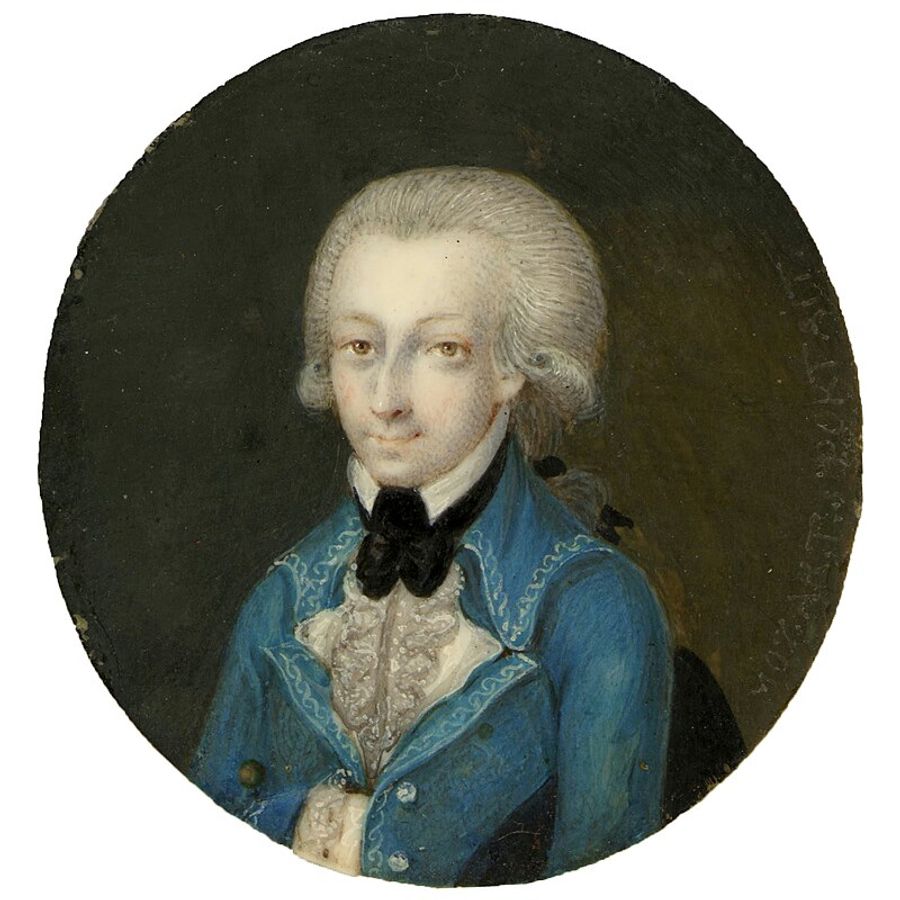
- Köchel Number
- K9 310 | K6 300d
- Genre
- Piano Music
- Form
- Piano Sonatas
- Key
- A Minor
- Date
- Summer 1778
- Place
- Paris
- Age
- 22
Mozart’s Piano Sonata No. 8 in A minor, K. 310 (1778) is the most volatile and dramatic of his early keyboard sonatas—written in Paris when he was 22, at the center of a journey that brought both professional frustration and personal catastrophe. Its hard-edged gestures, urgent harmonic turns, and tense rhetoric have long prompted listeners to hear it as a work of crisis, even as its craftsmanship remains unmistakably Classical.
Background and Context
Mozart’s Paris sojourn of 1778 sits at an awkward intersection of ambition and disillusion. He had come (with his mother, Anna Maria) to test the most prestigious musical capital in Europe, to secure patronage, and—ideally—to obtain a stable appointment. Instead he encountered a world of fickle taste, closed networks, and practical obstacles that repeatedly blocked him, even as he absorbed French orchestral color and theatrical pacing (most famously in the contemporaneous “Paris” Symphony, K. 297). Against that backdrop, the Piano Sonata in A minor, K. 310 stands apart not simply because it is in a minor key (rare in Mozart’s sonatas), but because it behaves like a work that refuses consolation.
The sonata’s expressive temperature has encouraged biographical readings ever since early Mozart commentators asked “what happened?”—a question sharpened by the fact that Mozart’s mother fell gravely ill in Paris and died there on 3 July 1778 [5]. Yet a cautious view is necessary: the surviving evidence does not let us map grief onto specific bars with certainty, and Mozart himself—remarkably—left no explicit mention of K. 310 in his letters [1]. What we can document, however, is a convergence of circumstances that made the sonata’s stark tone newly plausible: a young composer under intense pressure, cut off from Salzburg’s familiar support, negotiating Parisian musical commerce, and facing a family emergency that ended in bereavement.
One vivid contemporary window is Mozart’s letter written in Paris on 3 July 1778—the day of his mother’s death—in which he describes praying both for her “happy death” and for strength and courage for himself [6]. That document cannot “explain” K. 310, but it does confirm the emotional extremity of the period in which this sonata was composed.
Composition
K. 310 belongs to the triad of travel sonatas K. 309–311, later issued together in Paris as Heina’s Œuvre IV; as John Irving notes, the autograph places K. 310 in Paris, summer 1778 [1]. The autograph itself (preserved today as a key source for the text) even bears the inscription “Paris 1778” [2], anchoring the work securely to place and season.
Publication history adds a revealing Parisian footnote. The Henle preface to the sonatas K. 309–311 reports that Mozart likely sold these works shortly before leaving Paris (26 September 1778), and that François-Joseph Heina—personally involved during the Mozart family’s crisis—may have been someone to whom Mozart felt indebted [3]. This is an unusually concrete instance where biography, business, and textual transmission meet: a publisher who is not merely a name on a title page, but part of Mozart’s Paris network at precisely the moment life turned tragic.
Textually, the story is messier than performers sometimes assume. Heina’s first edition (the earliest printed witness) is described as being “full of mistakes,” and—critically—Mozart appears not to have proofread it, since from 1781 onward he had no further contact with Paris [3]. For modern players this matters: K. 310’s familiar surface can conceal editorial decisions, and serious editions tend to treat the autograph as the decisive authority when print sources conflict.
As to instrument: Mozart’s title pages and publishers of the period frequently marketed such works for “clavecin ou le forte-piano” (harpsichord or fortepiano), and K. 310 belongs to that transitional world. The writing exploits rapid contrasts, register, and articulation in ways that speak particularly well on a fortepiano—yet the piece’s success across instruments is also a reminder that Mozart composed for a market in which domestic keyboard types coexisted.
Form and Musical Character
K. 310 is a three-movement sonata whose drama is sustained not only by tempo and texture, but by a kind of rhetorical insistence: motifs return like arguments, not like ornaments.
Movement plan
- I. Allegro maestoso (A minor)
- II. Andante cantabile con espressione (F major)
- III. Presto (A minor)
I. Allegro maestoso
The opening is “maestoso” only in the most severe sense: it projects authority through sharp profile and nervous momentum. The movement’s sonata-allegro form (exposition, development, recapitulation) becomes a vehicle for tightening pressure rather than for balancing themes in a conversational manner. Particularly striking is how Mozart makes the left hand an active agent—driving, answering, and sometimes threatening to overpower the right—so that the familiar Classical texture (melody with accompaniment) is continually destabilized from within.
A useful way to hear the movement’s character is to listen for how often Mozart avoids letting a cadence feel like rest. Instead of “arriving,” the music frequently pivots, re-accelerates, or re-frames its materials, as if forward motion were an ethical imperative. This quality also aligns K. 310 with another Paris-period minor-key work, the Violin Sonata in E minor, K. 304—a pairing often discussed because both pieces inhabit an unusually shadowed expressive palette for Mozart in 1778 (even if the precise emotional trigger remains debated).
II. Andante cantabile con espressione
The slow movement’s key—F major—offers apparent relief, yet the instruction con espressione (“with expression”) is not mere sentiment; it signals an inwardness that can feel almost exposed after the first movement’s public severity. Formally, Mozart sustains long singing lines while allowing disquiet to appear in harmonic sidesteps and in the way phrases seem to hesitate before completing themselves.
This movement is also where performers most clearly confront the work’s interpretive debate: should the cantabile be “pure,” almost vocal and objective, or should it be tinged with the first movement’s anxiety? Both approaches can be persuasive, and the autograph-centered editorial tradition (given the unreliability of early prints) encourages pianists to treat articulation and slurring as expressive data rather than as decorative afterthought.
III. Presto
The finale compresses the sonata’s earlier tensions into a headlong argument. Its perpetual motion can suggest virtuosity, but the deeper effect is psychological: the music seems compelled to continue. The writing rewards clarity and lightness, yet it is not “light” music; the technical brilliance serves an almost breathless insistence.
In the broad sweep of Mozart’s keyboard output, K. 310’s ending is notable for how little it resembles the genial rounding-off found in many major-key sonatas. Instead, the final pages can feel like a refusal—an ending that closes the case rather than offering reconciliation.
Reception and Legacy
K. 310 has become one of the standard Mozart sonatas precisely because it complicates the common caricature of “Mozartian ease.” It gives performers a Classical text whose emotional weather is closer to Sturm und Drang than to salon charm, and it offers listeners an early example of Mozart sustaining a grim expressive world across a full multi-movement design.
Historically, its afterlife is also shaped by sources. Because Heina’s edition is error-prone and Mozart did not oversee it, the work stands as a textbook case for why “Urtext” culture matters in Mozart: the autograph is not a luxury for scholars, but the foundation for trustworthy performance materials [3]. Modern editions and recordings that foreground articulation, phrasing, and rhetorical pacing—rather than merely speed—tend to bring the piece’s underlying argument into focus.
If one wants a final, unusually concrete link between life and artifact, it is difficult to surpass the autograph’s own self-identification: “Paris 1778” [2]. Few Mozart keyboard works carry so direct a marker of time and place. Whatever one concludes about biography and interpretation, K. 310 remains a Paris document—written at 22, in a city that tested Mozart’s ambitions and, in the same summer, witnessed his most intimate loss.
Sheet Music
Download and print sheet music for Piano Sonata No. 8 in A minor, K. 310 from Virtual Sheet Music®.
Sources
[1] John Irving, “Three sonatas, K.309–11,” chapter in *Mozart’s Piano Sonatas: Contexts, Sources, Style* (Cambridge University Press) — origins, dating, and lack of documentary mention for K. 310.
[2] The Morgan Library & Museum — catalog record for the autograph manuscript of *Piano Sonata in A minor, K. 310*, including the inscription “Paris 1778.”
[3] G. Henle Verlag (Ernst Herttrich), preface PDF for Mozart piano sonatas K. 309–311 — notes on Paris sale to Heina, publication chronology, and errors in the first edition.
[4] Salzburg Mozarteum Foundation — biographical overview confirming Anna Maria Mozart’s death in Paris on 3 July 1778.
[5] Wikipedia — Anna Maria Mozart (Pertl): basic biographical data and death date/place (used here only for cross-checking).
[6] *The Letters of Wolfgang Amadeus Mozart* (English translation) — Paris letter dated 3 July 1778 describing Mozart’s response to his mother’s imminent death.