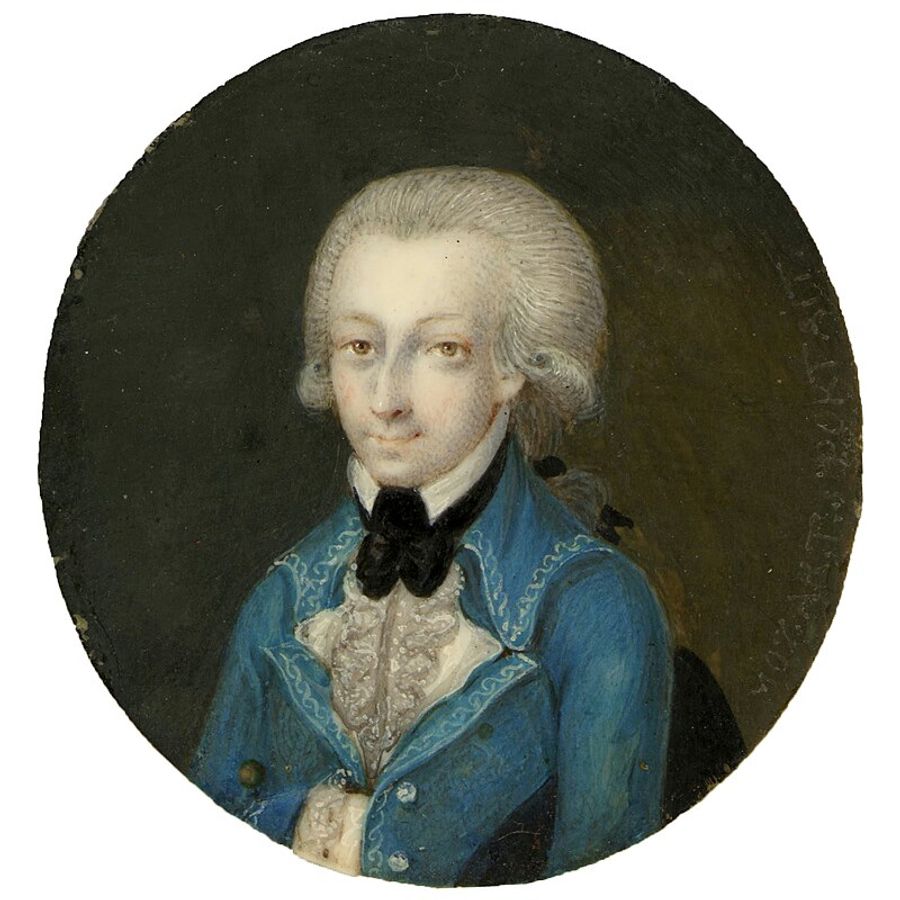
- Köchel Number
- K9 281 | K6 189f
- Genre
- Piano Music
- Form
- Piano Sonatas
- Key
- B Flat Major
- Date
- Early 1775
- Place
- Munich
- Age
- 19
Mozart’s Piano Sonata No. 3 in B♭ major, K. 281 (1775) belongs to the compact set of six “Munich” sonatas (K. 279–284), written when he was nineteen. Poised between courtly grace and theatrical wit, it repays attention for its unusually tender middle movement—marked Andante amoroso—and a finale whose humor already hints at Mozart the opera composer.
Background and Context
In the winter of 1774–75, Wolfgang Amadeus Mozart (1756–1791) was in Munich for the production of his opera La finta giardiniera (premiered January 1775). During this stay he produced a cluster of keyboard sonatas—K. 279–284—works that the family reportedly regarded as the “difficult” sonatas, modeled in part on the more ambitious solo sonatas then associated with Joseph Haydn’s example.[1] Whatever their immediate purpose (private use, teaching, or prospective patrons), these sonatas show Mozart writing “up” to a sophisticated, attentive listener rather than merely supplying polite domestic music.
K. 281 is often nicknamed the “Dürnitz” Sonata in modern reception, linking it to Baron von Dürnitz, a Munich amateur and later patron; the association is part of a broader narrative about Mozart’s circles in Munich, though the work itself stands securely on its musical merits.[2]
Composition
The Köchel catalogue places Piano Sonata in B♭ major, K. 281 in Munich in early 1775, within Mozart’s Munich residence (14 January–6 March 1775) during the La finta giardiniera period.[1] The sonata is conceived for the flexible keyboard world of the 1770s—harpsichord or the emerging fortepiano—where crisp articulation, quicksilver ornament, and dynamic nuance could all be brought into play depending on the instrument at hand.
Form and Musical Character
K. 281 is a three-movement sonata whose design looks conventional on paper, yet feels freshly individualized in the details:[2]
- I. Allegro (B♭ major)
- II. Andante amoroso (E♭ major)
- III. Rondo: Allegro (B♭ major)
The opening Allegro is a taut, bright sonata-allegro argument: themes are clearly profiled, but Mozart’s real pleasure lies in conversational textures—right-hand melody and left-hand counter-gestures that mimic operatic dialogue in miniature. Even at nineteen, he is already adept at making transitions feel like character changes: a turn of figuration, a sudden register shift, a light cadential delay.
The center of gravity is the slow movement. The marking Andante amoroso is strikingly specific, and it captures what listeners hear: a vocal, unforced lyricism that seems to “sing” rather than display.[3] In E♭ major (the subdominant), Mozart softens the rhetorical edge of the outer movements; the harmony moves with calm assurance, and the melodic line invites a player to think in breaths and vowels—an operatic instinct translated into keyboard cantabile.
The finale (Rondo: Allegro) restores brightness and adds a dose of stagecraft. Its recurring refrain is genial, yet the episodes can be teasingly unpredictable—rhythmic games, quick turns of harmony, and the kind of “timed” surprises that feel less like abstract development than like comic pacing. This is one reason K. 281 deserves attention within Mozart’s early sonatas: it does not merely practice forms, it dramatizes them.
Reception and Legacy
K. 281 has remained firmly in the pianist’s repertoire, aided by its balance of technical demands and immediate charm; it appears in modern scholarly and performing editions and is widely available in authoritative texts.[3][4] Historically, it also serves as a vivid “snapshot” of Mozart’s keyboard style just before the great Viennese leap of the 1780s: the musical language is already unmistakably his, but the scale remains intimate and portable.
For modern listeners, the sonata’s special claim is expressive range within a modest frame. The first movement’s poised classicism, the slow movement’s explicitly affectionate lyricism, and the finale’s theatrical humor together outline a young composer testing how much character a keyboard sonata can carry—an experiment that would culminate later in works of greater breadth, but rarely with more charm per page.
Sheet Music
Download and print sheet music for Piano Sonata No. 3 in B♭ major, K. 281 from Virtual Sheet Music®.
Sources
[1] Köchel-Verzeichnis (Mozarteum): contextual notes on the 1774/75 sonatas and Munich time window (14 Jan–6 Mar 1775).
[2] Wikipedia: overview of Piano Sonata No. 3, K. 281/189f (movements; common nickname usage).
[3] G. Henle Verlag: edition page discussing K. 281 and noting the unusual tempo marking *Andante amoroso*.
[4] IMSLP: score and publication/edition portal for Mozart’s Piano Sonata K. 281.