- Köchel Number
- K9 27 | K6 27
- Genre
- Chamber Music
- Form
- Violin Sonatas & Variations
- Key
- G Major
- Date
- February 1766
- Place
- The Hague
- Age
- 10
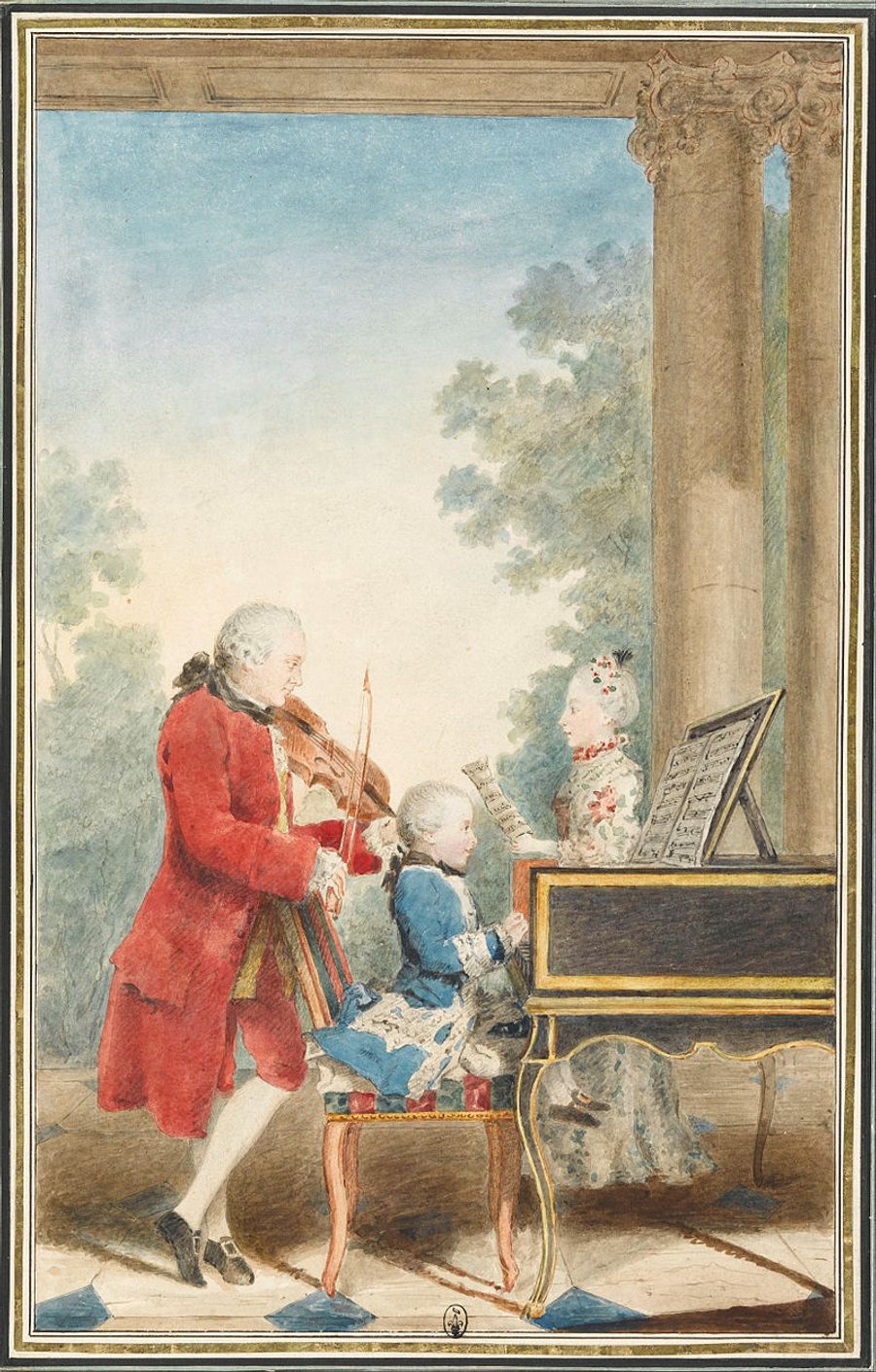
Mozart’s Violin Sonata No. 12 in G major (K. 27) was composed in February 1766 in The Hague, when the composer was only ten years old.[1] Cast as a keyboard sonata with optional violin accompaniment, it exemplifies how the “wonder child” wrote immediately usable music for travel, courtly occasions, and domestic performance—while already testing the expressive potential of a two-movement design.[2]
Mozart’s Life at the Time
In early 1766 Wolfgang Amadeus Mozart (1756–1791) was in the Netherlands as part of the family’s extended European tour (1763–1766), a demanding itinerary of performances, networking, and publication opportunities.[2] The Hague in particular proved unusually fertile: the young Mozart wrote keyboard pieces, variations on Dutch patriotic tunes, and—at local request—a compact set of six “sonatas for the harpsichord with violin accompaniment,” K. 26–31, later issued as Op. 4.[2]
K. 27 is the second sonata in that Hague group (often numbered “No. 12” in the long sequence of Mozart’s early keyboard-and-violin sonatas).[3]) These works remind modern listeners that, in the 1760s, the genre was still frequently conceived from the keyboard outward: the violin enriches, doubles, answers, and ornaments—yet the musical argument is carried primarily by the clavier.[2]
Composition and Manuscript
The Köchel catalogue places Violin Sonata No. 12 in G (K. 27) in February 1766 and locates it in The Hague.[1] The New Mozart Edition’s foreword preserves the most concrete context: Leopold Mozart reported in a letter of 16 May 1766 that, in The Hague, they “requested our little composer to write 6 sonatas for the keyboard with violin accompaniment” for Princess Caroline of Nassau-Weilburg, and that the set was “engraved immediately.”[2]
Publication was handled by the Hummel brothers (Burchard in The Hague; Johann Julius in Amsterdam), who also issued some of Mozart’s Dutch variations; MozartDocuments summarizes this publishing network and notes the dedication of K. 26–31 to Princess Caroline.[4] The result is music that sits at the intersection of courtly gift, commercial print, and practical repertory for the Mozarts’ own appearances.
For modern performers, K. 27’s transmission is not entirely “simple.” Henle’s editorial note for K. 26–31 explains that the New Mozart Edition had to reckon with an early copy “unrelated to Mozart,” whose additions could mislead; the point is not scandal, but a reminder that even modest juvenilia can accumulate textual noise in the sources.[5]
Musical Character
K. 27 is a concise, two-movement sonata—Adagio poco andante followed by Allegro—a plan confirmed both in modern reference descriptions and in the Hague set’s usual listings.[3]) The instrumentation likewise reflects mid-18th-century practice: a keyboard part (harpsichord, or today often fortepiano/piano) with a violin line that is genuinely present but conceived as accompaniment rather than equal protagonist.[2]
What makes this small work worth attention is precisely how clearly it shows the child composer learning a public musical language. The opening movement is not merely “slow music” pasted in front of something faster; it trains the ear to listen for singing line and balanced phrase structure—an early instance of Mozart’s lifelong instinct for cantabile writing, even in instrumental textures. The Allegro then turns to bright, rhetorical clarity: short motives, neat cadential punctuation, and keyboard figuration designed to sound fluent under the hands of capable amateurs.
Heard alongside Mozart’s later, truly dialogic violin sonatas of the Vienna years, K. 27 is best understood as a snapshot of an earlier genre concept—and of a ten-year-old already thinking in publishable, performable forms. Its modest scale is part of its charm: K. 27 offers a direct window onto the everyday musical economy of the Grand Tour, where elegance, immediacy, and practicality were not compromises but the point.
Sources
[1] Köchel catalogue entry list: K. 27—date (February 1766), place (The Hague), identification as Violin Sonata No. 12 in G.
[2] New Mozart Edition (NMA), VIII/23/1: editorial foreword and contextual documentation for the sonatas for keyboard with violin accompaniment (K. 26–31), including Leopold Mozart’s 16 May 1766 letter and publication details.
[3] Wikipedia overview page for Violin Sonatas K. 26–31: confirms Hague origin, dedication context, and movement list for K. 27 (Adagio poco andante; Allegro).
[4] MozartDocuments.org: background on the Hummel publishers in The Hague/Amsterdam and their publication of Mozart’s K. 26–31 sonatas dedicated to Princess Carolina of Nassau-Weilburg.
[5] G. Henle Verlag page for “Wunderkind”-Sonaten, K. 26–31: editorial note about sources (including an early copy unrelated to Mozart) and its impact on text-critical decisions.