- Köchel Number
- K9 22 | K6 22
- Genre
- Orchestral Music
- Form
- Symphonies
- Key
- B Flat Major
- Date
- December 1765
- Place
- The Hague
- Age
- 9
Mozart’s Symphony No. 5 in B♭ major, K. 22 is a compact, three-movement work composed in The Hague in December 1765, when he was only nine years old.1 Though far from a repertory staple, it offers a vivid snapshot of Mozart absorbing the mid-1760s symphonic idiom—especially the bright, public sonority of oboes and horns—while already shaping phrases with striking assurance.1
Mozart’s Life at the Time
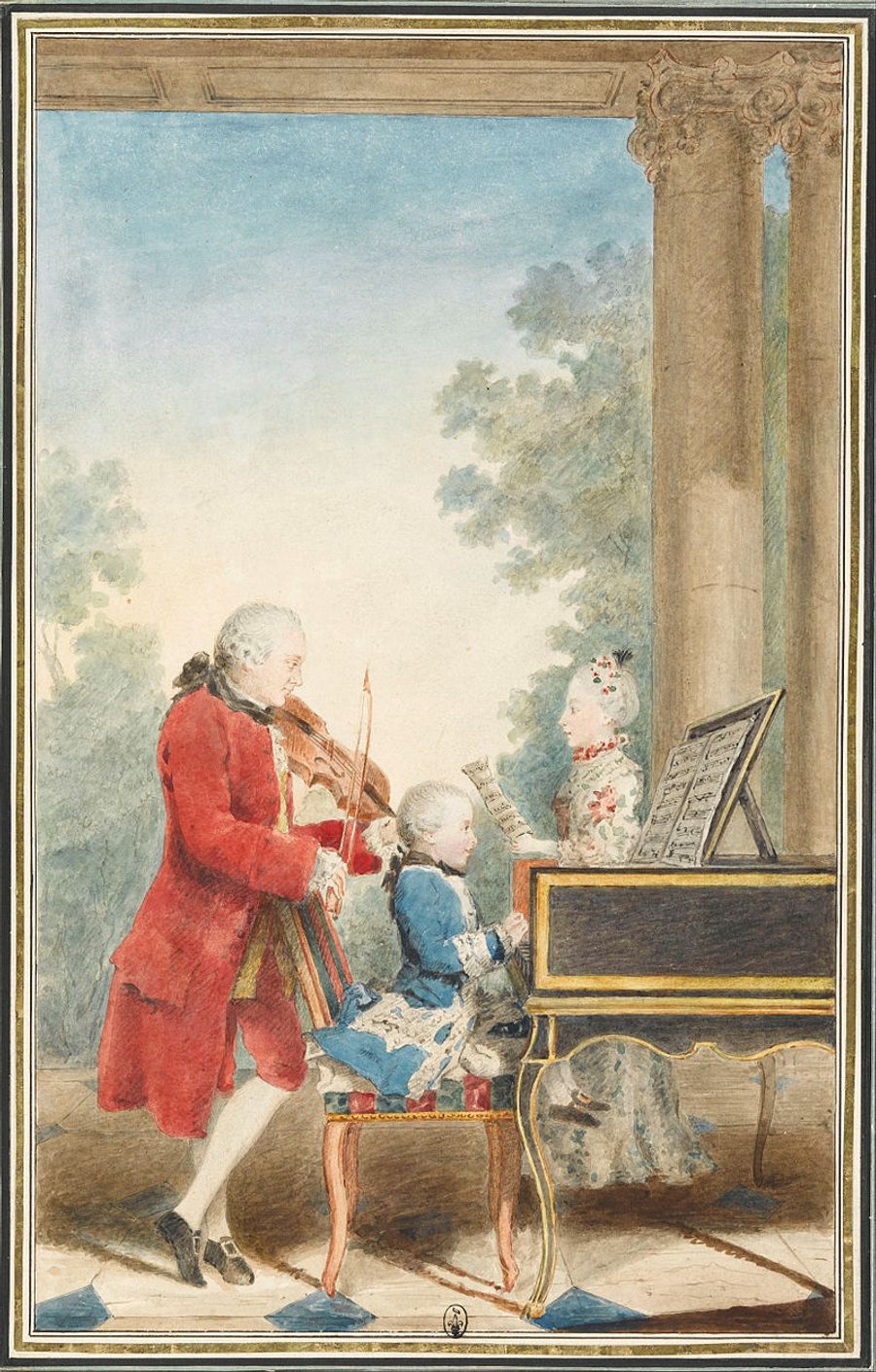
In late 1765, Wolfgang Amadeus Mozart (1756–1791) and his family were deep into the long European tour that displayed the prodigy to courts and concert audiences. Their stay in The Hague stretched from autumn 1765 into spring 1766, a period marked by public appearances but also by serious illness in the household.2 Mozart’s Symphony in B♭, K. 22 belongs to this Hague chapter and is dated to December 1765—music written by a child, yet clearly intended for adult listeners in a professional performance culture.1
For modern ears, K. 22 is best heard not as a “miniature precursor” to the late masterpieces, but as a document of how quickly Mozart learned to write for the practical realities of an 18th-century orchestra: clear tonal goals, strong cadences, and a bold, outdoor-leaning wind color that could carry in larger rooms.1
Composition and Manuscript
K. 22 was composed in The Hague in December 1765.1 It stands alongside the other early symphonies from the Grand Tour years—works that often function like sinfonie or Italian-style overtures, designed to make an immediate effect with brisk tempos, uncomplicated textures, and a direct theatricality.
The scoring is typical of Mozart’s earliest symphonic writing: strings with pairs of oboes and horns.1 That “small orchestra” is not a limitation so much as an aesthetic: the oboes sharpen the melodic profile and reinforce the upper strings, while the natural horns supply both harmonic pillars and a ceremonial sheen. Even when the writing is technically straightforward, the orchestral color is purposeful—one reason K. 22 can feel more characterful than its modest scale might suggest.1
Instrumentation
- Winds: 2 oboes
- Brass: 2 natural horns (in B♭)
- Strings: violins I & II, viola, cello, double bass1
Musical Character
K. 22 follows the three-movement pattern associated with the Italian overture (sinfonia): fast–slow–fast.1 In such works, one expects strong contrasts rather than deep motivic argument; nonetheless, Mozart already shows a knack for pacing and for giving each movement a distinct profile.
Movements
- I. Allegro (B♭ major)
- II. Andante (G minor)
- III. Allegro molto (B♭ major)1
The opening Allegro is concise, projecting confidence through bright tuttis and cleanly articulated phrases. What makes the symphony especially worth attention, however, is the choice of a minor-mode slow movement: the Andante in G minor lends an unexpectedly shaded center of gravity for such an early work.1 This is not “tragic” in the later Mozartian sense, but it does show a child composer comfortable with expressive contrast and darker orchestral tinting.
The finale (Allegro molto) restores the extrovert tone with quick-moving rhythms and a sense of public buoyancy. Heard as a whole, K. 22 demonstrates Mozart’s early mastery of proportion: the piece wastes little time, yet it suggests a larger dramatic arc—bright opening, shadowed middle, brisk release—that anticipates the expressive strategy of many later Classical multi-movement works.1