- Köchel Number
- K9 Anh.A 34 | K6 73t
- Genre
- Orchestral Music
- Form
- Dances & Marches
- Key
- E Flat Major
- Date
- Early August 1770
- Place
- Bologna
- Age
- 14
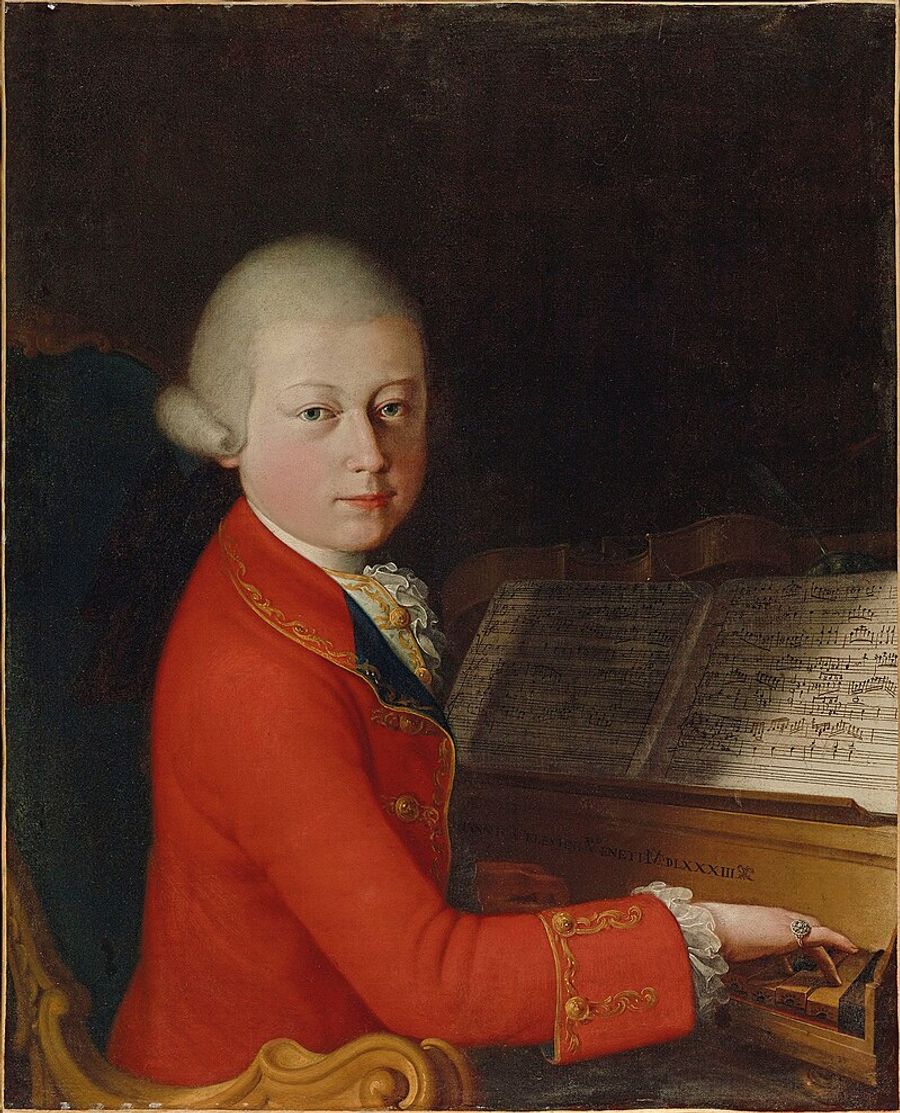
Mozart’s Minuet for Orchestra in E♭ major (K. 122; also catalogued as K. 73t in older Köchel cross-references) is a compact orchestral dance written during his first Italian journey, in 1770, when he was only fourteen. Though modest in scale, it offers a revealing glimpse of how quickly Mozart could absorb Italianate orchestral style and turn a courtly menuetto into a miniature scene for winds and strings.
Background and Context
In 1770, the fourteen-year-old Wolfgang Amadeus Mozart (1756–1791) was travelling through Italy with his father Leopold, collecting experiences that would accelerate his development in virtually every genre. The trip’s most famous Roman episode—the celebrated hearing of Allegri’s Miserere—tends to dominate the narrative, but the daily reality was a steady immersion in Italian orchestral sound, theatrical pacing, and the social rituals of aristocratic music-making.
A standalone orchestral minuet such as K. 122 belongs to that social world. The menuetto was not merely a symphonic “third movement” in embryo; it was a functional dance type—stylised, yes, but still tied to ballroom manners and to the kinds of short, performable pieces that could circulate among patrons and ensembles. For Mozart, writing dances in Italy also meant practising a compositional “craft language”: clear phrase structure, idiomatic wind writing, and a keen sense of how little material is needed to hold attention.
Composition and Premiere
The work is generally dated to 1770 and associated with Mozart’s Italian travels, with Rome frequently given as the place of composition in modern catalogue summaries [1]. (Older Köchel cross-references often list it as K. 73t, reflecting the complex history of Köchel revisions and supplementary numbers.)
No specific premiere is documented in the usual way for a symphony or concerto. That absence, however, is typical for occasional orchestral dances: they could be played privately, inserted into mixed entertainments, or used as reusable repertory by local ensembles. Today, the piece survives in modern editions and parts and appears in recordings and concert programming as a short orchestral interlude—evidence that, while not a “celebrity” work, it has remained practically performable [2].
Instrumentation
K. 122 is scored for a small Classical orchestra centered on strings with pairs of winds, an ensemble size typical of Mozart’s early Italian orchestral writing.
- Winds: 2 oboes, 2 horns
- Strings: violins I & II, viola, bass line (cello/double bass)
- Continuo (optional, period practice): harpsichord/organ reinforcing the bass line
The presence of two oboes and two horns is explicitly associated with the work in catalogue and reference listings [3]. In performance, the bass line may be realized by cellos and double basses, with a keyboard continuo sometimes added in historically informed contexts—less as a “soloist” role than as harmonic reinforcement.
Form and Musical Character
As a menuetto, K. 122 is built on the genre’s characteristic triple meter and balanced phrasing; it is music designed to feel regular and “walkable,” even when played as a listening piece rather than danced.
Minuet (E♭ major)
The minuet projects a confident E♭-major brightness—helped by the horns’ natural affinity for the home key and by the oboes’ ability to articulate the line with a lightly reedy brilliance. Mozart’s craft here is in proportion and orchestral colour: rather than treating the winds as mere doublers, the scoring suggests the young composer experimenting with the conversational surface that would later become second nature in his serenades and symphonies.
Listeners may also notice how this kind of Italian-travel minuet tends to be more than a “polite tick of the metronome.” Conductors and scholars discussing Mozart’s minuets often point out that some Italian-period examples invite broader tempo and more elaborate surface detail than later, more compact ballroom types—an early hint that the minuet could carry genuine expressive weight, not just social decorum [4].
Trio (contrasting middle)
Many minuets gain their charm from a Trio that thins the texture and shifts the spotlight—often toward strings alone or a reduced palette—before the da capo return of the Minuet. Whether performed as a formal dance pair or as a concert miniature, this contrast is the genre’s dramaturgy in miniature: “public” versus “private,” bright orchestral sheen versus chamber-like intimacy.
What makes K. 122 worth hearing is precisely this concentration. At fourteen, Mozart was already learning to imply a larger world with small means—an ability that would later serve him in the great symphonic minuets (and menuetti in serenades) where dance steps become theatre.
Reception and Legacy
K. 122 has never stood at the center of the repertory, and it does not seek to. Its value lies elsewhere: it documents Mozart’s working fluency during the Italian journeys, and it shows how the supposedly “minor” genre of orchestral dances could function as a laboratory for orchestration and phrase design.
Placed beside the youthful Italian symphonies and overture-like orchestral works from 1770–71, this minuet reminds us that Mozart’s style did not develop only through big public statements. It also grew through adaptable, socially embedded pieces—works meant to be picked up, played, and enjoyed without ceremony. Heard on its own, K. 122 is a concise, well-made example of the Classical menuetto at the moment when Mozart was turning travel, listening, and professional necessity into lasting technique.
Sources
[1] All About Mozart — Köchel catalogue table entry listing “Minuet for Orchestra” K. 122 in E♭ major (1770; Rome) and NMA category reference.
[2] IMSLP — “Minuet in E-flat major, K.122/73t” page (editions, parts, work identifiers).
[3] Köchelverzeichnis PDF (Saengerbund Efringen-Kirchen) — listing for KV 122 with instrumentation (2 oboes, 2 horns, strings/bass).
[4] College Music Symposium — article on tempo choices in Mozart’s minuets, with remarks relevant to Italian-period minuets and their proportions.