- Köchel Number
- K9 113 | K6 113
- Genre
- Orchestral Music
- Form
- Serenades, Cassations & Divertimenti
- Key
- E Flat Major
- Date
- November 1771
- Place
- Milan
- Age
- 15
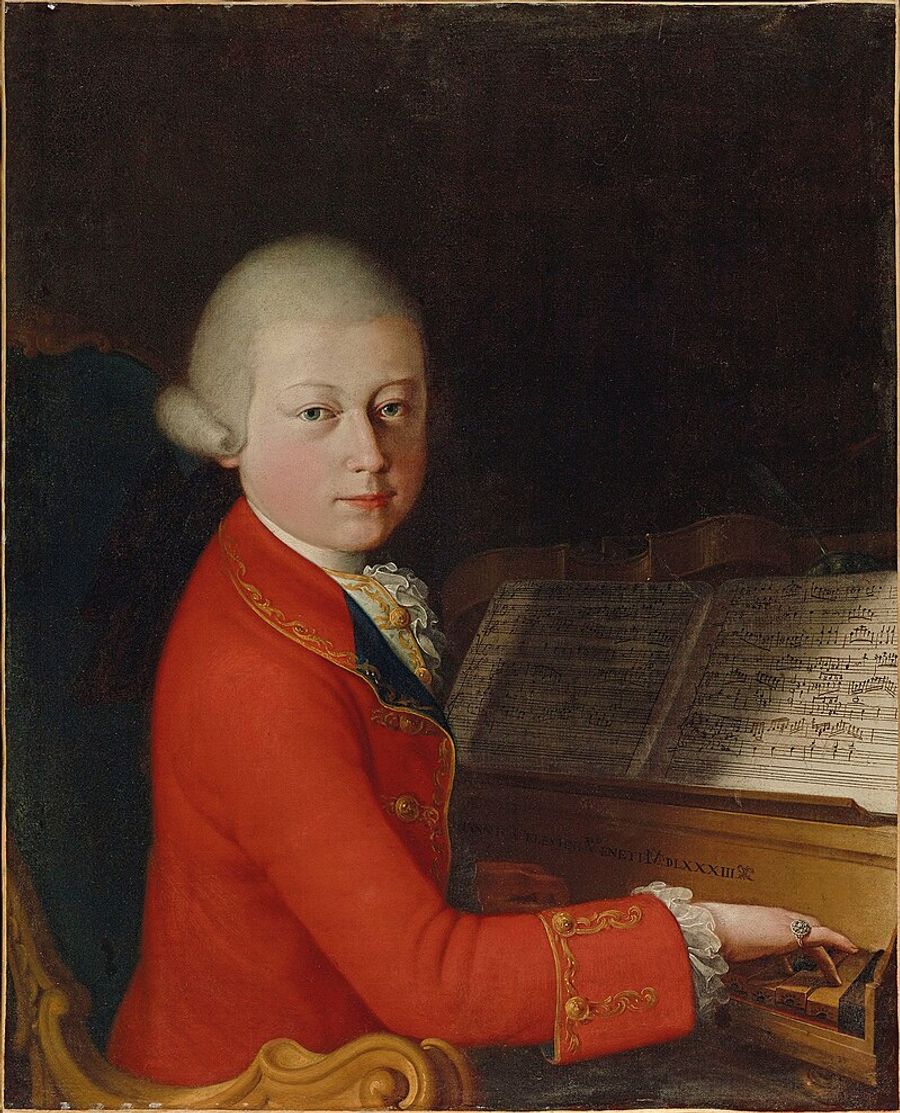
Mozart’s Divertimento No. 1 in E♭ major (K. 113) is an orchestral cassation-type work from his Milan period, dated November 1771—when he was just fifteen. Modest in scale yet strikingly colorful in its wind writing (including early clarinets), it shows the teenage Mozart testing the boundary between light outdoor entertainment and the emerging Classical symphony.
Background and Context
In the 18th century, a divertimento (and its close cousins, the cassation and serenade) typically served social life: evening music for aristocratic households, garden festivities, or subscription concerts where elegance and variety mattered as much as depth. Mozart wrote many such “occasional” works across his career, but Divertimento No. 1 in E♭ major, K. 113 is a special early marker: it is one of the first in which he treats wind instruments not merely as harmonic support, but as conversational partners that can shape the piece’s identity.[1])
The circumstances of its creation point squarely to Mozart’s Italian professional ambitions. In 1771 he was in Milan for his second Italian journey, undertaken largely to oversee and benefit from the production of his festa teatrale Ascanio in Alba (premiered in Milan on 17 October 1771). The divertimento belongs to this same world: a young composer moving in courts and theaters, absorbing Italian taste for clear melodic profile and quick theatrical contrasts.[1])
What makes K. 113 deserve attention today is precisely this blend of function and experimentation. It may not aim for the psychological drama of the later symphonies, yet it is not mere “background music.” Its scoring, its concertante impulses, and its compact four-movement plan show Mozart trying out symphonic thinking—light-footed, but already purposeful.
Composition and Premiere
The autograph score bears an inscription by Leopold Mozart—“Concerto ò sia Divertimento à 8”—dated to Milan in November 1771, a rare piece of documentary clarity for an early orchestral divertimento.[1])[2] The same sources and later scholarship link the work to a Milan subscription concert on 22 or 23 November 1771, possibly at the residence of Albert Michael von Mayr (often identified in discussions of the event as a key host for such concerts).[1])
Even the title in Leopold’s hand is telling. Calling it “concerto or divertimento” points to the genre-fluidity of the moment: entertainment music could borrow the concerto’s spotlighting of players, and a “divertimento” might present itself with the seriousness (or at least the prestige) of a public concert work. Listeners will indeed notice how frequently the winds step forward in duet-like figures, as if auditioning for a concerto platform.
Instrumentation
K. 113 is best known today in the “first version” scoring associated with the Milan autograph and early performance tradition. The work is scored for:
- Winds: 2 clarinets (in B♭)
- Brass: 2 horns (in E♭; in F for the second movement)
- Strings: violins I & II, viola, cello, double bass
This is a quietly remarkable sound palette for 1771. Clarinets were still relatively new in many orchestral contexts, and Mozart’s use of them here is not tokenistic: they often share the melodic foreground with the horns, creating a warm, blended timbre that suits E♭ major particularly well.[1])
A further wrinkle is that Mozart later produced (or authorized) a re-scoring that expands the wind complement substantially (with pairs of oboes, clarinets, English horns, bassoons, and horns), reflecting both the adaptability of divertimento repertory and the practical reality that available players could vary by place and occasion.[1]) For modern listeners, the first-version scoring remains the cleanest window into the Milanese sound world that surrounded the Mozarts in late 1771.
Form and Musical Character
K. 113 unfolds in four movements—one reason it can feel surprisingly “symphonic” in outline, even though its musical rhetoric remains more genial than weighty.[1])
- I. Allegro (E♭ major)
- II. Andante (B♭ major)
- III. Menuetto – Trio (Trio in G minor)
- IV. Allegro (E♭ major)
I. Allegro
The opening Allegro is bright and outward-facing, its themes designed for immediate recognition rather than long-range transformation. Yet the movement’s most engaging feature is its texture: Mozart repeatedly treats the paired clarinets and horns as if they were soloists, setting them into exchanges with the strings and with each other. This “concertante” habit—foregrounding a small group within an orchestral frame—helps explain why Leopold could plausibly label the work Concerto ò sia Divertimento.[1])
II. Andante
The Andante (in the subdominant region of B♭ major) softens the profile. Here the winds’ capacity for sustained cantabile (songful line) comes to the fore, and the horns’ change of crook to F for this movement underscores that Mozart conceived the color and key scheme with practical detail in mind.[1]) Rather than operatic drama, the mood suggests refined conversation—an intimate interlude within a public evening.
III. Menuetto – Trio
The minuet is “traditional” in its courtly gait, but Mozart gives the Trio an expressive turn by shifting to G minor.[1]) This is more than a routine contrast: the minor-mode Trio briefly darkens the divertimento’s otherwise sunny demeanor, a hint of emotional shading that anticipates Mozart’s later ease in moving between social surface and inner feeling.
IV. Allegro
The finale Allegro is lively and concise, built to send the audience away energized. Again, the prevailing impression is one of instrumental sociability: winds and strings are not arranged in rigid hierarchy, but in a flexible, performance-friendly dialogue. The movement’s momentum—quick gestures, clean cadences, bright E♭ sonorities—fulfills the divertimento’s primary promise: to delight without overstaying its welcome.
Reception and Legacy
K. 113 has never been among the most frequently programmed Mozart orchestral works, in part because it sits between categories: not a “symphony” in name, not chamber music, and not tied to a famous public commission. Yet its legacy is quietly significant.
First, it documents Mozart’s early engagement with clarinets in an orchestral setting—an engagement that would later flower in some of his most beloved instrumental writing. Second, it shows him shaping a four-movement plan that mirrors the symphonic norm, but with the lighter manners expected of Milanese entertainment music in 1771. Finally, the work’s multiple scorings underline a historical truth sometimes forgotten in modern concert culture: divertimenti were living repertory, expected to be adapted to circumstances and players.[1])
For listeners coming to K. 113 today, its charm lies not only in youthful brilliance, but in craft: the sure sense of proportion, the elegant wind coloration, and the instinct for public-facing clarity. It is Mozart, fifteen years old, writing music that knows exactly what it is for—while already hinting at what he will later become.
Sheet Music
Download and print sheet music for Divertimento No. 1 in E♭ major (K. 113) from Virtual Sheet Music®.
Sources
[1] Wikipedia: overview of Mozart’s Divertimento No. 1, K. 113 (date, context in Milan, movements, and scoring; discussion of multiple versions).
[2] Deutsche Digitale Bibliothek: catalog entry for the autograph (Staatsbibliothek zu Berlin), including Leopold Mozart’s title/inscription and Milan November 1771 dating.