Wolfgang Amadeus Mozart

Music must never offend the ear.

Latest Posts

Explore fresh analyses, background notes, and posts about Mozart's works.

Loading latest posts…

The Life of a Genius

Born January 27, 1756 at 9 Getreidegasse, Salzburg, Wolfgang Amadeus Mozart emerged as history's most remarkable child prodigy, transforming into the greatest composer of the Classical era.
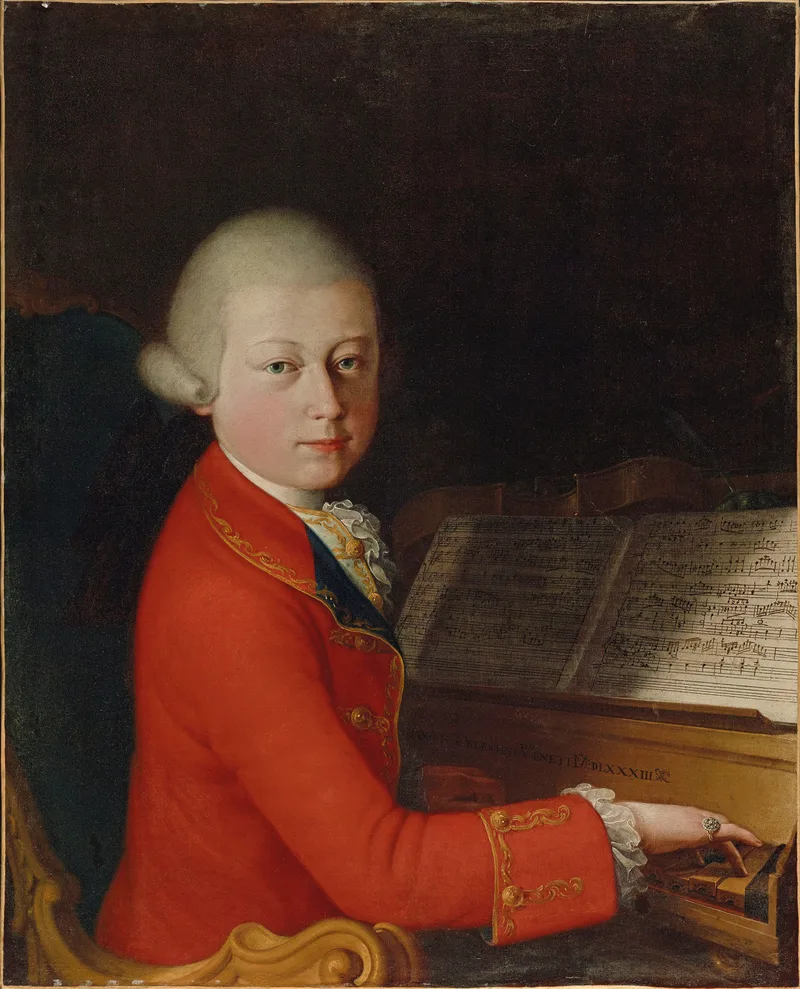
Child Prodigy

Child Prodigy

1756 - 1773

Early Years in Salzburg

Wolfgang Amadeus Mozart was born on January 27, 1756, at 9 Getreidegasse in Salzburg's old town. His father, Leopold Mozart, served as deputy Kapellmeister at the Prince-Archbishop's court and recognized Wolfgang as "the miracle which God let be born in Salzburg."

By age 4, Wolfgang was picking out harmonies on the keyboard. At 5, he composed his first piece and was competent on both keyboard and violin. Leopold organized extensive European tours from 1763-1773, during which young Mozart performed before emperors, kings, and nobility across the continent.

The family lived in the third-floor apartment at Getreidegasse until 1773. Only Wolfgang and his sister Maria Anna "Nannerl" survived infancy of the seven Mozart children, both becoming exceptional musicians under their father's dedicated guidance.

Born: January 27, 1756, Salzburg

Life Timeline

1756

Birth in Salzburg

Born January 27, 1756 at 9 Getreidegasse, Salzburg. Son of Leopold Mozart, deputy Kapellmeister at the Archbishop's court, and Anna Maria Pertl Mozart.

1761

First Compositions

At age 5, Mozart composes his first piece of music and demonstrates extraordinary musical abilities on keyboard and violin.

1763

Grand European Tours

Leopold takes 7-year-old Wolfgang and sister Nannerl on extensive 3.5-year concert tour across Europe, performing for royal courts.

1773

Return to Salzburg

Family returns to Salzburg after decade of touring. Mozart serves Archbishop Colloredo as Konzertmeister.

1781

Vienna Independence

Mozart breaks with Archbishop Colloredo and moves to Vienna to establish himself as a freelance composer and performer.

1784

Peak Vienna Years

Moves to Domgasse 5, his most prestigious Vienna residence. Composes 'The Marriage of Figaro' and Haydn Quartets.

1791

Final Masterpieces

Completes 'The Magic Flute' and begins his Requiem. Dies December 5, 1791 in Vienna at age 35, leaving the Requiem unfinished.

Mozart in the News

Stay updated with the latest Mozart performances, discoveries, and classical music events around the world.

Loading latest Mozart news...

Masterful Compositions

Explore Mozart's vast catalog of over 600 compositions. Click any composition to hear audio samples and discover famous recordings.

Symphony No. 41 "Jupiter"

K. 551 • C major

Mozart's final and greatest symphony, composed in 1788. The finale demonstrates unprecedented contrapuntal mastery with five themes combined simultaneously.

1788

Symphony No. 40

K. 550 • G minor

One of only two symphonies Mozart wrote in a minor key. Famous for its urgent, dramatic opening theme and emotional intensity throughout.

1788

Die Zauberflöte (The Magic Flute)

K. 620 • E♭ major

Mozart's final opera, premiered September 30, 1791. A German singspiel combining Masonic symbolism, Enlightenment ideals, and sublime music.

1791

Le Nozze di Figaro (The Marriage of Figaro)

K. 492 • D major

Composed at his Domgasse residence with libretto by Lorenzo Da Ponte. A comic masterpiece exploring class conflict and human nature.

1786

Don Giovanni

K. 527 • D major/minor

The second of the Da Ponte trilogy. A dramma giocoso about the legendary seducer, blending comedy with supernatural drama.

1787

Piano Concerto No. 20

K. 466 • D minor

Mozart's most popular piano concerto, written in the dramatic key of D minor. Premiered with Mozart himself as soloist.

1785

Piano Concerto No. 21

K. 467 • C major

Famous for its sublime slow movement, known as the "Elvira Madigan" concerto after its use in the 1967 film.

1785

Requiem

K. 626 • D minor

Mozart's final composition, commissioned anonymously. Left unfinished at his death and completed by his pupil Franz Süssmayr.

1791

Eine kleine Nachtmusik

K. 525 • G major

A serenade for strings, one of Mozart's most recognizable works. Originally had five movements, but one is now lost.

1787