- Köchel Number
- K9 Anh.C 11.08 | K6 Anh. C 11.08
- Genre
- Orchestral Music
- Form
- Symphonies
- Key
- F Major
- Date
- c. 1769
- Place
- Salzburg?
- Age
- 13
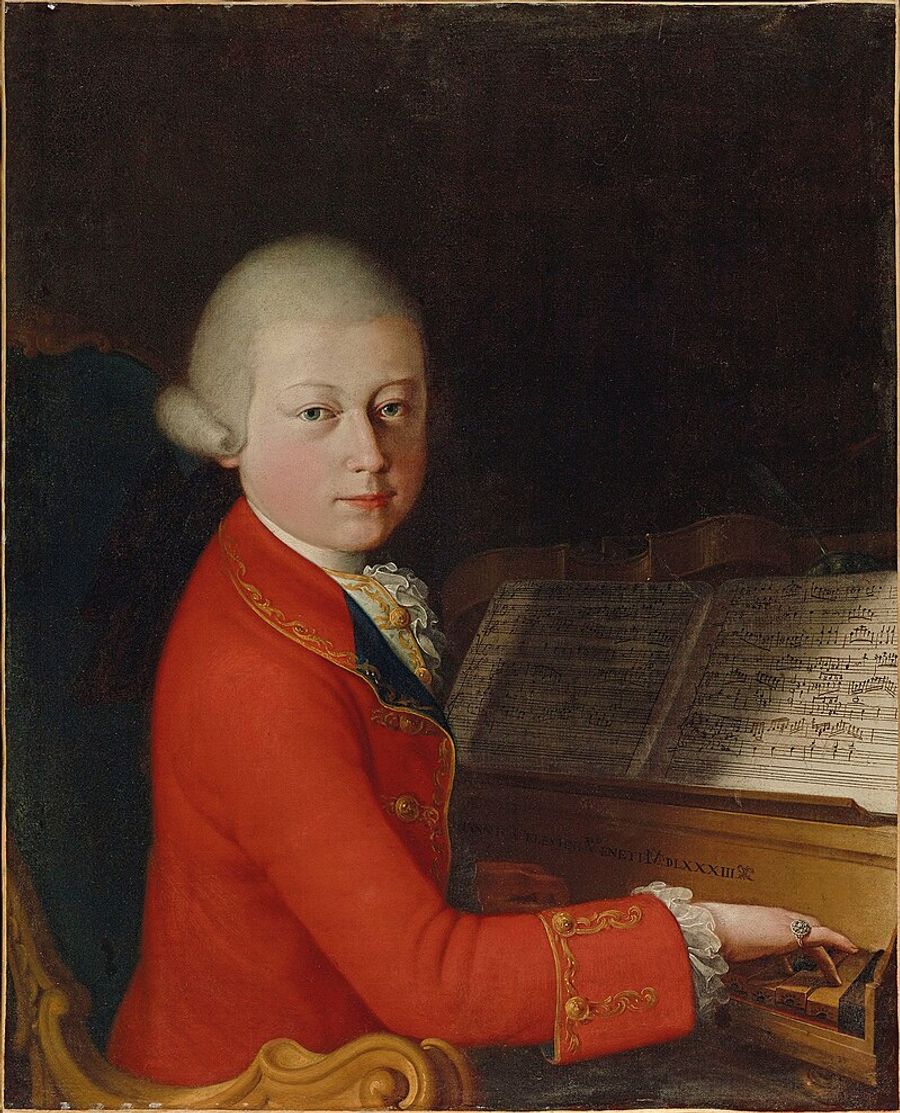
Mozart’s Symphony in F major (K. Anh.C 11.08) is a lost and doubtful work, tentatively dated to 1769—when he was 13 and based mainly in Salzburg. Today it is known only from a brief thematic incipit preserved via the Breitkopf & Härtel manuscript catalogue tradition, leaving its scoring, scope, and even authorship uncertain.
Background and Context
In 1769, Wolfgang Amadeus Mozart (1756–1791) was 13—newly returned to Salzburg after the family’s extended travels, and on the verge of his first Italian journey later that year. The Symphony in F major now catalogued as K. Anh.C 11.08 is usually placed in this Salzburg-centered moment, but survives only as a documentary trace rather than a performable composition.[1][2]
Modern reference lists treat K. Anh.C 11.08 as lost and of doubtful authenticity. In other words, while it was at some stage transmitted under Mozart’s name, the evidence is too thin to accept it confidently as genuine.[1]
Musical Character
The work is known only from a four-bar incipit (opening idea) reported in the Breitkopf & Härtel manuscript catalogue tradition.[1] As reproduced in reference literature, the incipit outlines a concise F-major gesture in alla breve (2/2), beginning with a tonic F and a characteristic little turn of fast notes before a clear cadential settling—music that sounds compatible with the “portable,” brightly articulated orchestral idiom of mid-century symphonies.[3])
Beyond those opening bars, however, there is no secure basis for describing movements, formal design, or orchestration. In practice, K. Anh.C 11.08 functions less as an extant symphony than as a shadow of one: a remembered incipit without the structure that would normally turn such a beginning into a complete multi-movement work.[1]
Place in the Catalog
Among the lost symphonies associated with Mozart’s name, K. Anh.C 11.08 is routinely singled out as one whose authorship remains uncertain; accordingly, it is commonly excluded from enumerations of Mozart’s authenticated symphonies.[2] Even so, its tentative 1769 dating places it—at least on paper—near the period in which Mozart was rapidly consolidating the symphonic language that would soon deepen through Italian influences and later Salzburg practice.[2]
Sources
[1] Wikipedia: list entry for K. Anh.C 11.08 as lost and doubtful; notes it is known only by a four-bar incipit in the Breitkopf & Härtel manuscript catalogue.
[2] Wikipedia: general list of Mozart symphonies noting K. Anh.C 11.08 is lost and of uncertain authorship, and is therefore not included among the numbered/authenticated symphonies.
[3] Wikipedia: Symphony K. 74g article reproducing (in a table of doubtful/lost symphonies) the LilyPond incipit for K. Anh.C 11.08 in F major and summarizing its status as lost/doubtful.