Canon in B♭ for Three Voices, “Leck mir den Arsch fein recht schön sauber” (K. Anh.A 39)
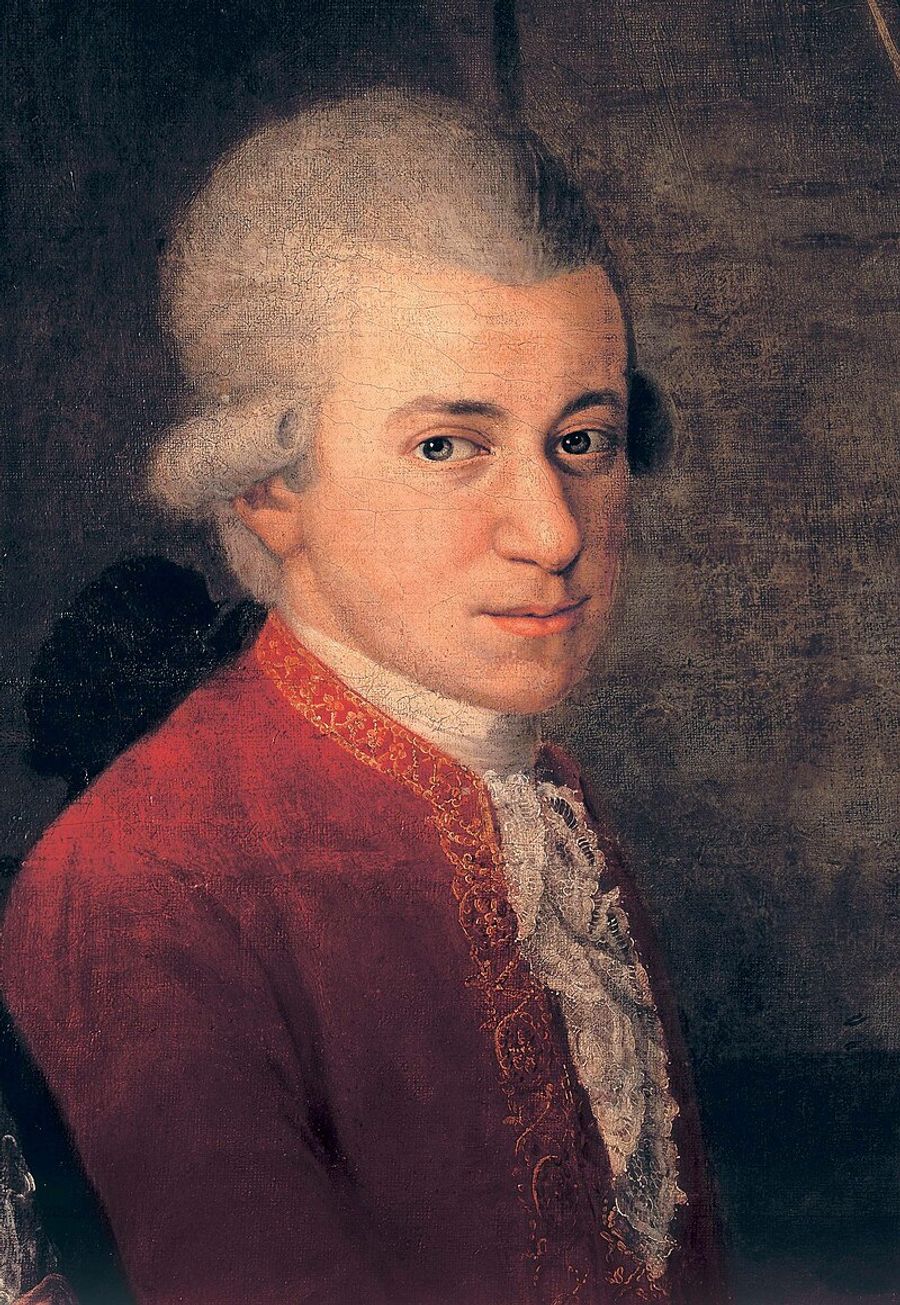
- Köchel Number
- K9 Anh.A 39 | K6 382d
- Genre
- Sacred Music
- Form
- Smaller Church Works
- Key
- B Flat Major
- Date
- 1782
- Place
- Vienna
- Age
- 26
The three-voice canon “Leck mir den Arsch fein recht schön sauber” (K. Anh.A 39) is a brief B♭-major Kanon associated with Mozart’s Vienna years (dated 1782) and the convivial, after-hours music-making of his circle. Its text is explicitly obscene, and modern scholarship commonly links the music to the physician-composer Wenzel Trnka, with Mozart’s role most plausibly lying in the German contrafactum (replacement text). [1] [2]
Background and Context
Despite occasional cataloging baggage that can mislead the unwary, this is not a liturgical item but a private joke-piece: a compact three-part canon preserved among the short canons that circulated in Vienna’s sociable music culture. The Köchel-Verzeichnis at the International Mozarteum Foundation dates the work to 1782 and transmits it with a complicated source picture that includes copies explicitly naming Wenzel Trnka. [1]
The Neue Mozart-Ausgabe’s critical report identifies Trnka as composer and describes the principal source used for the edition as a score-style notation deriving from a (now-unknown) Mozart copy. In other words, the piece belongs to Mozart’s documented habits as a collector, adapter, and disseminator of canons within his circle—even where authorship of the underlying music may point elsewhere. [2]
Musical Character
Scored for three unaccompanied voices in a single movement, the canon is written as a tight, singable line designed for quick uptake and overlapping imitation—music meant to be launched by one singer and immediately “caught” by the others. The notation and layout in the sources present it as a straightforward convivial Kanon for three equal parts, with an alternative polite text (“Nichts labt mich mehr als Wein”) sometimes attached in transmission. [1] [3]
The B♭-major setting and compact contrapuntal premise place the emphasis less on harmonic journey than on the comic friction of precise ensemble and verbal timing—an aesthetic entirely at home beside the more serious contrapuntal work Mozart pursued in Vienna in his mid-twenties, but here redirected toward a deliberately crude punchline for friends rather than the concert hall. [2]
Sources
[1] International Mozarteum Foundation (Köchel-Verzeichnis): work entry for KV Anh. A 39 with dating, key, instrumentation, and transmission notes.
[2] Neue Mozart-Ausgabe (DME Mozarteum): Kritischer Bericht III/10 (Canons) — source description and attribution notes for KV 233/382d (incl. composer listed as Wenzel Trnka).
[3] IMSLP: general information page for the canon (K.233/382d), confirming key, scoring (3 voices), and alternate title/text tradition.