- Köchel Number
- K9 66 | K6 66
- Genre
- Sacred Music
- Form
- Masses & Requiem
- Key
- C Major
- Date
- October 1769
- Place
- Salzburg
- Age
- 13
Mozart’s Missa in C major, “Dominicus” (K. 66) is a youthful but strikingly assured setting of the Ordinary of the Mass, completed in October 1769 in Salzburg—when the composer was just 13. Written for a specific local celebration and cast on a festive, “solemn” scale, it already shows Mozart thinking like a church Kapellmeister: shaping large liturgical spans with chorus, soloists, and bright ceremonial color.
Mozart’s Life at the Time
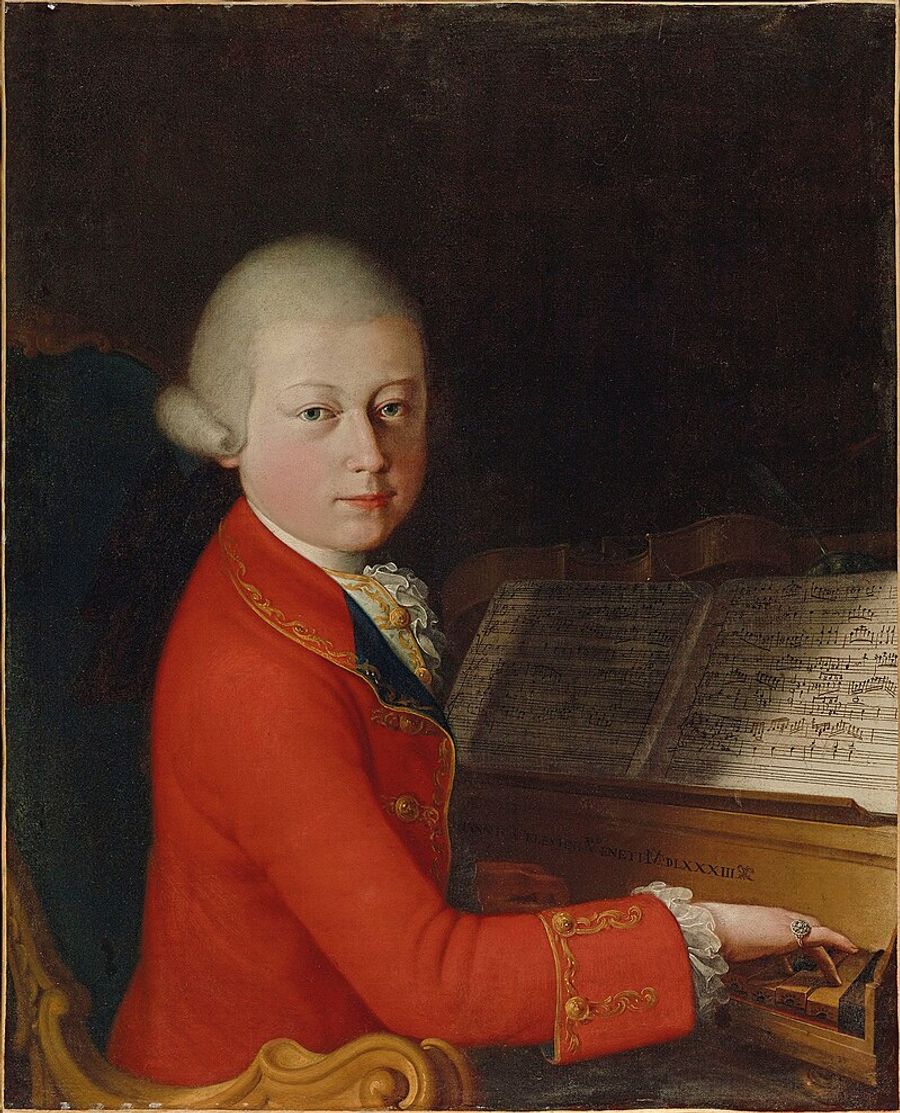
In 1769 Wolfgang Amadeus Mozart (1756–1791) was back in Salzburg after the long “grand tour” years, newly 13, and increasingly drawn into the city’s everyday musical needs—especially church music. The Missa in C major, K. 66 belongs to this moment of consolidation: the prodigy turning local professional, writing for the institutions and performers he knew best.
The mass is tied to the Benedictine milieu of Salzburg: it takes its familiar nickname from Pater (Father) Dominicus Hagenauer, whose first solemn mass provided the occasion, with the premiere given on 15 October 1769 in Salzburg (often identified with St Peter’s Abbey/Monastery church). Leopold Mozart conducted, and contemporary reports describe a crowded church—an early public success in Mozart’s home city, not simply a family salon triumph.[2][5]
Composition and Manuscript
Mozart completed K. 66 in October 1769 in Salzburg, and it stands as a complete setting of the Ordinary (Kyrie, Gloria, Credo, Sanctus, Benedictus, Agnus Dei). The Köchel catalogue entry at the International Mozarteum Foundation preserves the basic work-identification and dating, and modern scholarship treats it as one of the earliest Salzburg masses in which Mozart aims for an explicitly festive public profile rather than a purely functional, compact missa brevis.[1][2]
Surviving sources and modern editorial work (including discussion in the Neue Mozart-Ausgabe) underline that this is not an apprentice fragment but an ambitious cathedral/monastic commission in miniature—an early example of Mozart writing “up” to ceremonial expectations, with timpani and trumpets signaling high feast-day brightness.[5]
Musical Character
K. 66 is often described as a missa solemnis, and the scoring supports that impression: a four-part choir with soloists, orchestra, and continuo/organ, with brass and timpani lending a public, processional sheen.[2][3]
A practical overview of the performing forces (as commonly given in modern choral catalogues and study aids) is:
- Voices: SATB choir; SATB soloists[3]
- Winds: 2 oboes; (some movements call for flutes in certain editions/parts traditions)[3]
- Brass: 2 trumpets; 2 horns[3]
- Percussion: timpani[3]
- Strings: violins I & II, viola, basso
- Continuo: organ (with basso continuo)
What makes the “Dominicus” Mass especially worth attention is how quickly the 13-year-old Mozart moves between liturgical “categories” of expression. Jubilant, extroverted choral writing sits beside more intimate, solo-weighted passages (for instance, the liturgy’s moments of supplication and personal address), and the shifts are handled with a sense of proportion that anticipates the teenage Salzburg masterpieces of the early 1770s.[3]
Stylistically, K. 66 lives in the sound-world of Salzburg church music before Archbishop Colloredo’s later pressures toward brevity: ceremonial opening gestures, clear tonal architecture in C major, and choruses that favor lucid homophony (text clarity) while still allowing Mozart to show contrapuntal training when the rhetoric invites it. In short, it is juvenilia not because it is slight, but because it reveals a major compositional intelligence learning how to write for a liturgy—projecting splendour without losing momentum, and matching musical affect to the Mass text with remarkable instinct.
Sources
[1] International Mozarteum Foundation, Köchel Catalogue entry: KV 66 — Missa in C “Dominicus-Messe” (work identification, key, dating)
[2] Wikipedia: Mass in C major, K. 66 “Dominicus” (overview, nickname/occasion, premiere date tradition)
[3] Vocal Music in the Italian Institute (VMII): K. 66 Missa in C (text/translation and movement-by-movement performing forces as commonly given)
[4] IMSLP: Mass in C major, K. 66 (editions and access to scores/parts)
[5] Neue Mozart-Ausgabe (NMA) critical/introductory material (PDF via dme.mozarteum.at) discussing sources and context for KV 66