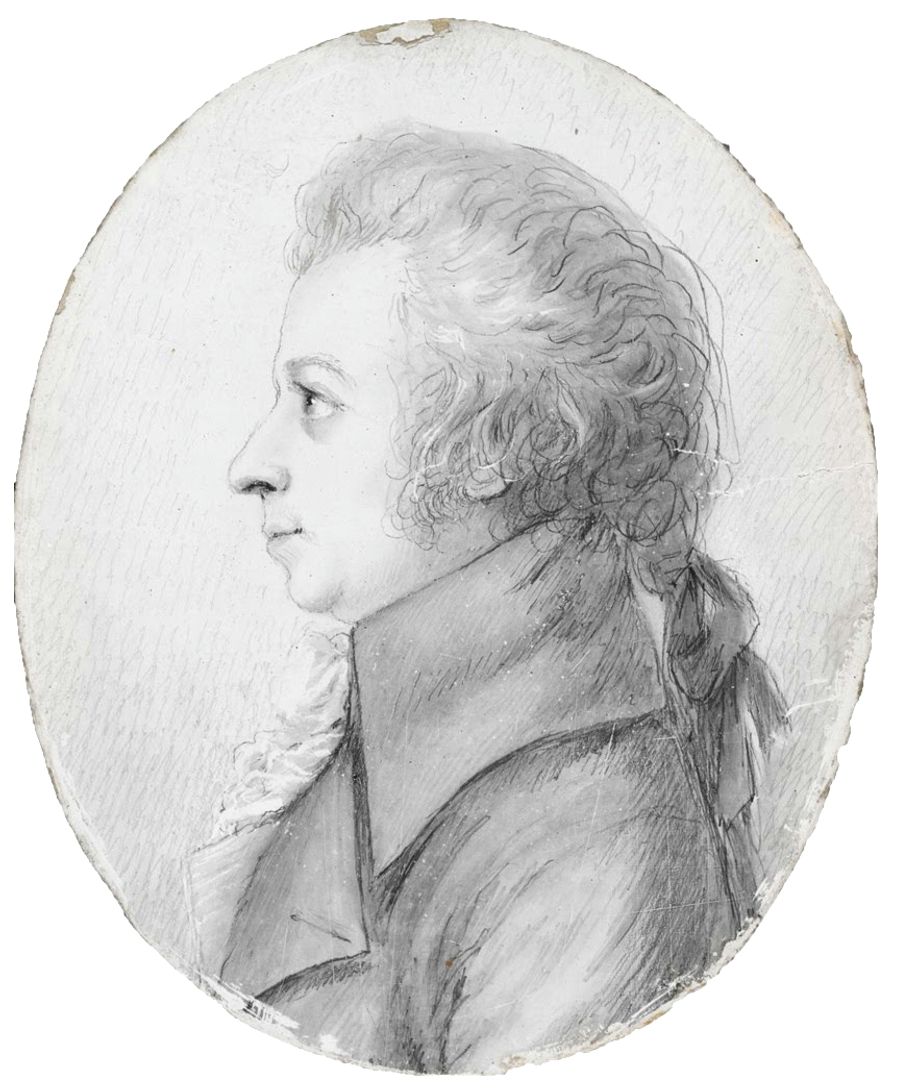
- Köchel Number
- K9 530 | K6 530
- Genre
- Vocal Music
- Form
- Lieder
- Key
- E Flat Major
- Date
- 6 November 1787
- Place
- Prague
- Age
- 31
Mozart’s Das Traumbild (K. 530) is a compact yet unusually poignant German Lied for voice and keyboard, completed in Prague on 6 November 1787. Written while the composer was still basking in the success of Don Giovanni, it shows Mozart turning from the theatre to an intimate miniature—one that deserves attention for its quiet psychological ambiguity and its finely balanced Classical lyricism.[1]
Background and Context
Mozart composed Das Traumbild (K. 530) in Prague on 6 November 1787—just days after Don Giovanni had premiered there on 29 October.[3] The Köchel catalogue and the Internationale Stiftung Mozarteum both place the song firmly in this Prague period, specifying E♭ major and scoring for voice and clavier (keyboard).[1]
Its immediate social destination was not the public concert hall but the cultivated circle of Mozart’s Viennese friends—above all the Jacquin family. The song is bound up with Mozart’s friendship with Gottfried von Jacquin, an amateur musician and occasional composer: Mozart mailed him “the song” shortly after finishing it, in a letter dated 4 November 1787 (a document that also brims with news from Prague and Mozart’s practical travel plans).[3] Later accounts note that Jacquin had the piece copied into a small song collection that circulated under his own name—an episode that helps explain why K. 530 remained comparatively little known in the 19th century.[2]
Text and Composition
The text is by Ludwig Christoph Heinrich Hölty (1748–1776), a poet associated with the Göttingen Hainbund. In its published form the poem appears under the title “Das Traumbild” (and is linked to Hölty’s earlier “An ein Traummädchen”); it stages a lover’s anxious search for a girl glimpsed in a dream—tenderly observed in details (rosemary, violets, a “swan-white hand”) yet haunted by the possibility that the vision cannot be recovered.[2]
Musically, Mozart treats the poem as a strophic Lied—each stanza set to essentially the same music.[2] That choice matters: rather than “following” the poem line by line with changing musical imagery (as in a through-composed ballad), K. 530 lets the text circle obsessively through repeated musical time, mirroring the speaker’s repeated looking—“now by the village lindens, now in the town”—without finding the beloved.[2]
Musical Character
The scoring is deceptively simple: Voice and keyboard.[1] Yet within this modest frame, E♭ major becomes an expressive space of memory—warm, poised, and slightly idealized. The keyboard part supports a clear, singable line rather than competing with it; the vocal writing is grateful to the breath, suggesting performance in a salon rather than a theatre.
What makes Das Traumbild distinctive in Mozart’s song output is precisely this restraint. In comparison to the overt drama of his best-known German song, Das Veilchen (K. 476), K. 530 cultivates a more inward lyric: it avoids big rhetorical “turns,” and instead sustains a single mood—half reverie, half unease—over the repeated strophes.[2] This can sound, at first hearing, almost plain; but in context it is a deliberate Classical poise, a refusal to over-interpret a text whose point is uncertainty.
Within Mozart’s 1787 output—dominated by opera, travel, and the demands of public success—Das Traumbild is the opposite of grand gesture: a private, carefully made miniature. That it emerged in Prague, amid the afterglow of Don Giovanni, only sharpens its appeal. K. 530 offers a glimpse of Mozart at 31 turning (briefly) from the stage to the solitary voice: not to depict a character, but to listen to a mind searching for something it cannot quite name.[1]
Sources
[1] Internationale Stiftung Mozarteum (Köchel-Verzeichnis): KV 530 “Das Traumbild” — dating (Prague, 6 Nov 1787), key (E♭ major), scoring (voice & clavier), authenticity and publication notes.
[2] Wikipedia: “Das Traumbild” — overview, Jacquin context, poem background (Hölty), and basic form (strophic).
[3] Digital Mozart Edition (DME), letter: Mozart to Gottfried von Jacquin, dated Prague, 4 November 1787 (English transcription PDF) — documents the correspondence context and refers to sending “the song.”