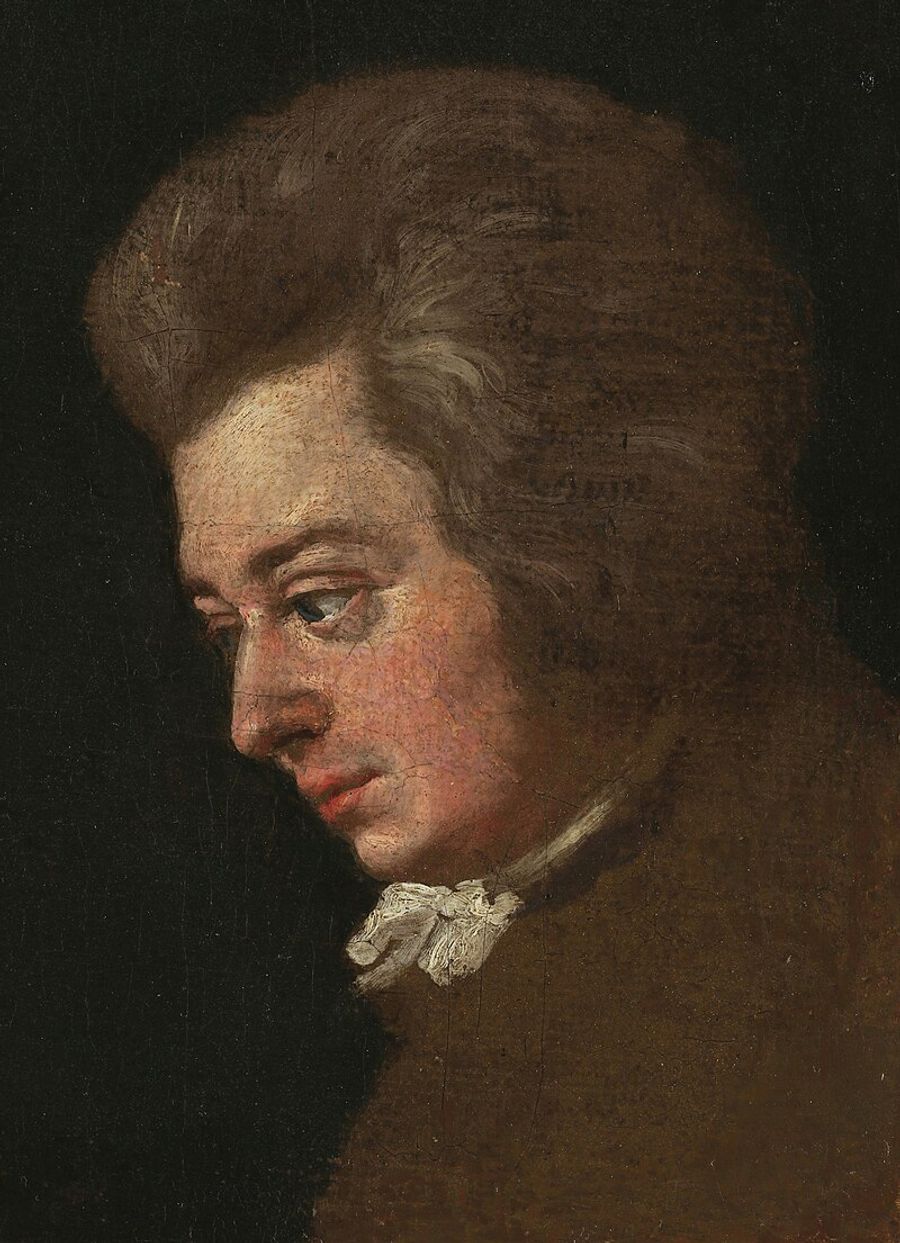
- Köchel Number
- K9 498 | K6 498
- Genre
- Chamber Music
- Form
- Piano Quintets, Quartets & Trios
- Key
- E Flat Major
- Date
- 5 August 1786
- Place
- Vienna
- Age
- 30
Mozart’s Trio in E♭ major for piano, clarinet and viola (K. 498), completed in Vienna on 5 August 1786, is one of his most original chamber works—an intimate conversation among three instruments that rarely meet as equals. Often called the “Kegelstatt” (“skittle-alley”) Trio, it pairs lyrical warmth with a quietly radical sense of ensemble balance.
Background and Context
Vienna in 1786 was a year of remarkable stylistic breadth for Wolfgang Amadeus Mozart (1756–1791): while Le nozze di Figaro was taking shape for the theatre, he was also cultivating a refined domestic chamber style for friends, pupils, and connoisseurs. The Trio in E♭ major (K. 498) belongs to this sociable Viennese world—music intended less for public display than for alert, pleasurable listening and skillful amateur performance.
What makes K. 498 distinctive, even in Mozart’s famously inventive chamber output, is its instrumentation: piano, clarinet, and viola. This is not merely a novelty. The clarinet and viola share a similar vocal range and timbral warmth, allowing Mozart to weave their lines together in close duet, while the piano does far more than accompany—it often initiates ideas, completes phrases, and comments with contrapuntal finesse. Later composers would treat this combination as a viable genre, but Mozart’s trio stands as its foundational classic.[1]
Composition and Dedication
Mozart dated the autograph manuscript 5 August 1786 in Vienna, placing the trio squarely in the same late-summer period that also produced the Duos for Two Horns K. 487 (whose autograph carries Mozart’s famous skittles inscription).[2][3] The nickname “Kegelstatt” is frequently linked to this milieu of games and music-making. Modern scholarship, however, treats the “composed while playing skittles” story cautiously: the skittles note appears securely on K. 487, and the trio’s nickname likely grew from association rather than hard documentation.[4][3]
The trio is closely associated with clarinetist Anton Stadler—Mozart’s leading Viennese clarinet collaborator—and with the Jacquin household (notably Mozart’s pupil Franziska von Jacquin). The Neue Mozart-Ausgabe commentary notes the work’s likely performance context in this circle and reports that it was performed at the Jacquins’ with Mozart on viola and Stadler on clarinet.[3]
Although written in 1786, K. 498 was published later: Artaria issued it in Vienna in 1788. To broaden sales, the print offered the clarinet line as an alternative to a violin part—an early sign that publishers were unsure how large the market was for this unusual scoring.[5][3]
Form and Musical Character
Instrumentation
- Winds: clarinet (typically in B♭)
- Strings: viola
- Keyboard: piano
Movements
- I. Andante (E♭ major)
- II. Menuetto with Trio (E♭ major; contrasting middle section)
- III. Rondeaux: Allegretto (E♭ major)
One of the trio’s most striking formal choices is its avoidance of an opening fast movement: Mozart begins with an Andante, immediately setting a tone of conversational intimacy rather than concerto-like brilliance.[3] The writing often feels vocal—phrases are shaped as if sung—yet the three players trade roles continually. The viola is not relegated to inner filler; it frequently answers the clarinet in close imitation, or takes over a melodic thread while the clarinet provides an enveloping counterline.
The Menuetto is similarly subtle. Its dance character is present, but Mozart treats the minuet less as ballroom music than as a framework for chamber interplay: the piano’s articulation and the string–wind blend matter as much as the tune itself. The finale, a Rondeaux: Allegretto, crowns the work with genial wit—refrains return with the ease of spoken repetition, while episodes explore coloristic combinations (clarinet–viola duet, piano-led turns of phrase) that make the trio feel perpetually renewed.
Across all three movements, Mozart’s most modern-seeming achievement may be ensemble equality. Rather than “soloist plus accompaniment,” K. 498 behaves like three intelligent speakers in a small room: lines overlap, complete each other’s thoughts, and occasionally fall into brief, luminous consensus.
Reception and Legacy
K. 498 occupies an important place in Mozart’s Viennese chamber music of the mid-1780s, alongside works that rethink familiar genres through new sonorities (such as the Quintet for Piano and Winds, K. 452, and the two piano quartets).[6] If it is not as universally famous as Mozart’s later clarinet concerto or clarinet quintet, it deserves attention for showing an earlier stage of his clarinet imagination—less public, more inward, and unusually dependent on the viola’s warm middle voice.
Its publication history also reveals its quiet boldness: Artaria’s 1788 edition effectively “translated” the clarinet line into a violin alternative, a practical compromise that nonetheless underscores how forward-looking Mozart’s original conception was.[5][3]
Today the “Kegelstatt” Trio remains a cornerstone of the clarinet–viola–piano repertoire: a work whose charm is immediate, but whose craftsmanship—balanced voicing, harmonic poise, and conversational rhetoric—continues to reward players and listeners far beyond any bowling-alley anecdote.
Sheet Music
Download and print sheet music for Trio in E♭ major for Piano, Clarinet and Viola, “Kegelstatt” (K. 498) from Virtual Sheet Music®.
Sources
[1] Overview of the clarinet–viola–piano trio genre and Mozart’s K. 498 as a key early example
[2] Autograph manuscript image (dated 5 August 1786) via Wikimedia Commons / Bibliothèque nationale de France
[3] Neue Mozart-Ausgabe (NMA), Series VIII, Workgroup 22: Piano Trios — critical report/commentary (English PDF) discussing context, circle of performers, and publication details
[4] Bärenreiter edition page with editorial note about the skittles anecdote and its uncertain status
[5] IMSLP work page with first edition/publisher information (Artaria, Vienna 1788) and related bibliographic notes
[6] Köchel-Verzeichnis entry (Mozarteum) for KV 498, placing the work within Mozart’s Viennese chamber output