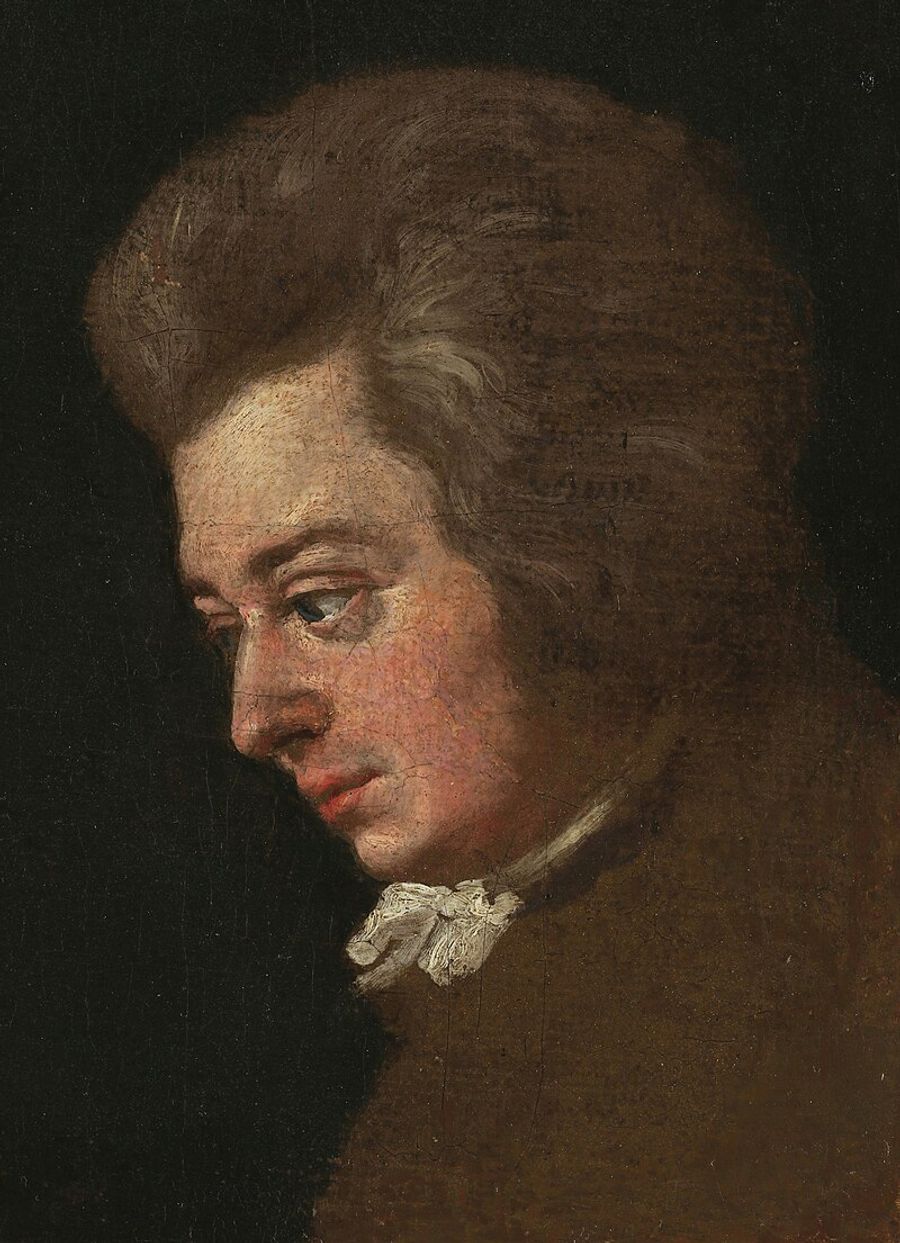
- Köchel Number
- K9 493 | K6 493
- Genre
- Chamber Music
- Form
- Piano Quintets, Quartets & Trios
- Key
- E Flat Major
- Date
- 3 June 1786
- Place
- Vienna
- Age
- 30
Mozart’s Piano Quartet No. 2 in E♭ major (K. 493) was completed in Vienna on 3 June 1786 and stands as one of the earliest masterpieces to treat the piano quartet as true four-part chamber music rather than “keyboard with accompaniment.” Written when Mozart was 30, it blends concerto-like brilliance with an unusually conversational equality among the strings—music of genial surface that is, on closer hearing, full of structural poise and surprise.
Background and Context
By the mid-1780s, Wolfgang Amadeus Mozart (1756–1791) had transformed Vienna’s keyboard culture through his piano concertos and a stream of sophisticated chamber works for the salon and the subscription concert. The piano quartet—piano with violin, viola, and cello—was still a relatively new genre, poised between domestic music-making and public virtuosity. Mozart’s decisive contribution was to raise its ambitions: the piano part can be as demanding as a concerto solo line, yet the strings are not relegated to mere support.
The backdrop is also pragmatic. Mozart’s first piano quartet, the stormy Piano Quartet in G minor (K. 478), proved a hard sell to amateurs, and his publisher Franz Anton Hoffmeister reportedly released him from a contract for a set of three such works. Yet Mozart composed a second quartet anyway, suggesting artistic conviction: K. 493 is not a retreat into simplicity, but a refinement—more luminous in affect, and even more masterly in balancing four independent voices.[2]
Composition and Dedication
Mozart completed the Piano Quartet in E♭ major (K. 493) in Vienna on 3 June 1786.[2][1] It belongs to a remarkable concentration of mature works from this period—months that also saw major stage activity (Le nozze di Figaro premiered in May 1786) and a continued flowering of chamber idioms in which Mozart tests how “public” virtuosity can live inside an intimate ensemble.
The scoring is the classical piano quartet standard: piano, violin, viola, and cello.[3] No specific dedicatee is securely attached to the work in the manner of some later chamber compositions; what matters more is its implicit dedication to a new kind of listening, where four players must negotiate prominence bar by bar.
Instrumentation
- Keyboard: fortepiano (piano)
- Strings: violin, viola, cello[3]
Form and Musical Character
K. 493 follows the three-movement plan associated with concerto and chamber sonatas, but Mozart’s handling is strikingly orchestral in texture and at times almost symphonic in breadth.
Movements
- I. Allegro (E♭ major)
- II. Larghetto (A♭ major)
- III. Allegretto (E♭ major)[3]
I. Allegro
The opening has a public, “tutti”-like confidence—an effect often noted by commentators, as if a miniature orchestra has been compressed into four instruments.[4] Yet what makes the movement distinctive is not volume but distribution: the piano sparkles, but the strings repeatedly claim thematic material, answer in imitation, or underpin the harmony with purposeful independence. In other words, the pianist cannot simply “lead”—the ensemble must speak with one articulated, flexible rhetoric.
Mozart’s E♭-major world is also carefully chosen. In his Viennese output, E♭ major often invites a warm, ceremonial tone; here it helps Mozart reconcile virtuosity with geniality. The surprises are subtle: sudden shifts into minor coloration, quick changes of register, and cadences that feel inevitable only after they happen.
II. Larghetto
The slow movement in A♭ major (the subdominant) brings an intimate, vocal kind of lyricism. The piano often sings in long phrases, but the strings do not merely cushion it; instead, they supply counter-melodies and tender harmonic turns that complicate the apparent simplicity. The result is a chamber “aria” in which accompaniment becomes character.
III. Allegretto
The finale is a bright rondo—a refrain-based form in which a recurring principal theme frames contrasting episodes. Contemporary program notes frequently emphasize Mozart’s joy and inventiveness here, but the deeper point is craft: each return of the refrain is freshly re-scored or re-angled, and the episodes let the strings step forward with wit and poise rather than functioning as a backdrop to keyboard display.[5]
Reception and Legacy
Historically, these two piano quartets (K. 478 and K. 493) sit close to the “moment of invention” for the genre. Later composers—from Beethoven onward—would find in them a persuasive model for integrating a keyboard instrument into chamber dialogue without reducing the strings to mere accompaniment.[6]
K. 493 deserves attention precisely because it is not flamboyant in an obvious way. Its innovation is social as much as musical: it asks four players to collaborate as equals while still allowing the piano the brilliance expected in Vienna’s keyboard-centered culture. In performance, the work rewards listeners who follow the hand-offs—melody migrating from piano to violin, inner voices (often viola) becoming momentarily decisive, the cello doing more than bass-line duty. In sum, it is Mozart at his most civil and most radical: reimagining a fashionable medium as serious chamber conversation.
Sources
[1] Classic Cat — Mozart chronology listing K. 493 with date (3 June 1786) and Vienna.
[2] Wikipedia — overview and context for Piano Quartet No. 2, including completion date and Hoffmeister contract anecdote.
[3] IMSLP — Piano Quartet in E-flat major, K. 493: instrumentation and movement listing.
[4] Earsense — chamber music notes discussing the work’s orchestral/tutti-like opening character.
[5] Santa Barbara Chamber Music Society — program notes (Nov 2024) describing the rondo finale and the work’s timbral/ensemble possibilities.
[6] Wikipedia — Beethoven Piano Quartets page noting Mozart’s two piano quartets as key comparable contemporary contributions to the genre.