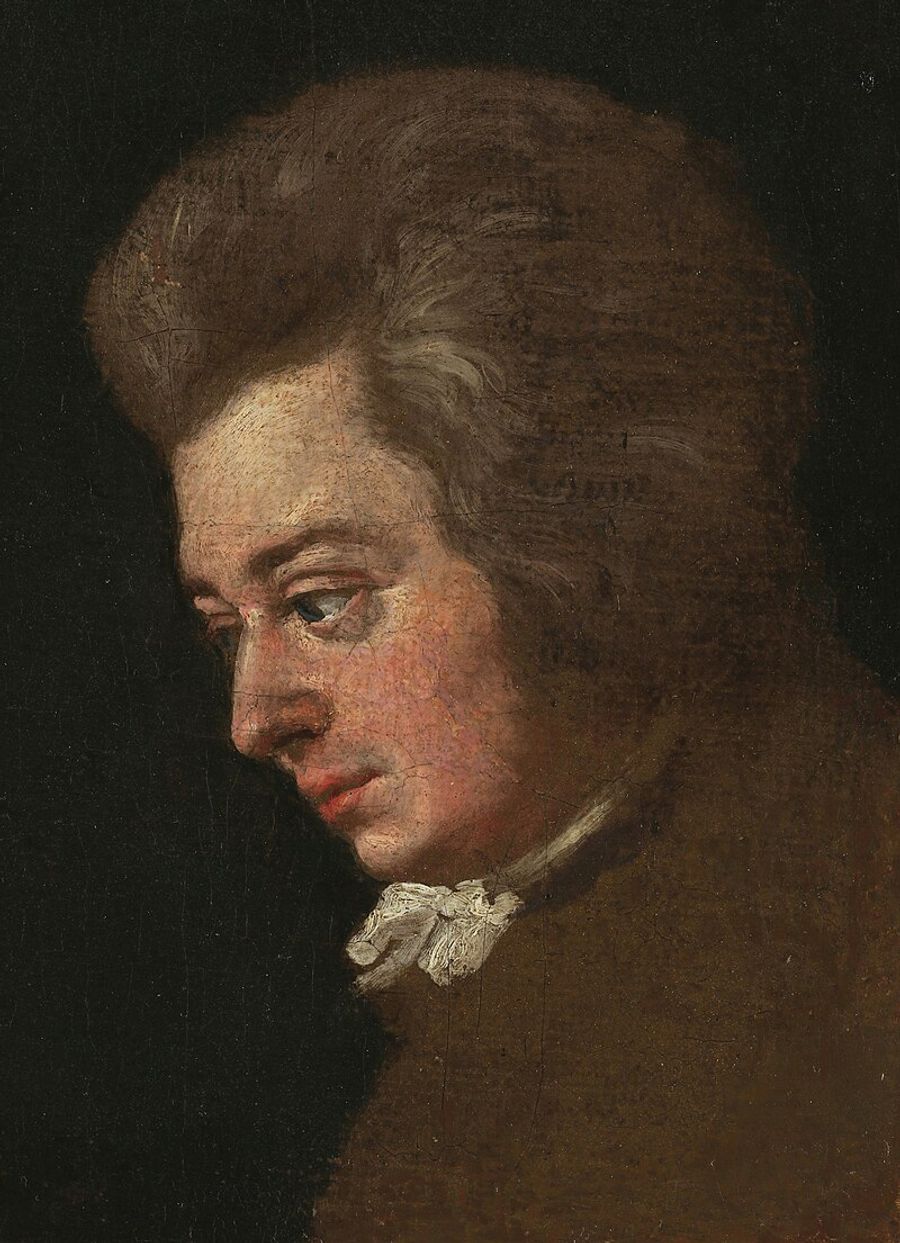
- Köchel Number
- K9 458 | K6 458
- Genre
- Chamber Music
- Form
- String Quartets & Wind Quartets
- Key
- B Flat Major
- Date
- 9 November 1784
- Place
- Vienna
- Age
- 28
Mozart’s String Quartet in B♭ major, K. 458—the celebrated “Hunt” quartet—was entered in his own thematic catalogue on 9 November 1784 and belongs to the six quartets he later published in Vienna as Op. 10 with a dedication to Joseph Haydn [1] [2]. Its opening movement’s 6/8 horn-call topic gives the work its enduring nickname, but the quartet’s deeper interest lies in how Mozart turns a public, outdoorsy musical sign into an unusually intricate, egalitarian conversation for four indoor string instruments.
Background and Context
Vienna in 1784 was, for Wolfgang Amadeus Mozart (1756–1791), a year of professional consolidation rather than courtly security: he was a celebrated pianist-composer in the city’s subscription and salon culture, writing for patrons, publishers, and his own concert life. The string quartet occupied a special place within this world. Unlike the piano concerto (a vehicle for Mozart the performer), the quartet was a compositional arena in which public reputation depended on what other professionals could see—and play—on the page.
The immediate backdrop is Joseph Haydn’s redefinition of quartet style in the early 1780s (especially the Op. 33 set), which made the genre feel newly “modern”: witty, motivically tight, and conversational rather than politely accompanied melody. Mozart’s response was not rapid imitation but long-term apprenticeship. When Artaria finally issued the set of six quartets in September 1785 as Mozart’s Op. 10, Mozart framed them as hard-won works—“the fruit of a long, laborious effort,” as one later editorial preface quotes from the dedication text [3]. K. 458 is the fourth in that published sequence.
The nickname “The Hunt” (Jagdquartett) can mislead, as if the piece were descriptive or picturesque in a Romantic sense. What is actually “hunting” here is a musical topic—a conventional set of gestures (compound meter, triadic calls, tonic–dominant emphasis) associated with real hunting horns and aristocratic outdoor ritual. Mozart’s accomplishment is that he adopts those gestures at the surface while the quartet’s interior working is anything but rustic.
Composition and Dedication
Mozart entered K. 458 in his personal thematic catalogue on 9 November 1784, giving unusually strong documentary footing for the work’s completion date [1]. That catalogue—his Verzeichnüss aller meiner Werke—is itself one of the most valuable self-authored documents in eighteenth-century music history: each entry couples a date and description with a musical incipit, turning the book into a kind of compositional diary [4] [5].
The quartet’s broader identity, however, is inseparable from the Haydn dedication. The Köchel-Verzeichnis online entry places K. 458 among the six quartets Mozart “showed his indebtedness” by dedicating to Haydn—K. 387, 421, 428, 458, 464, and 465—issued by Artaria in Vienna as Op. 10 [2]. The dedication was not merely a polite public gesture; it was embedded in private music-making where Haydn’s authority mattered.
A key contemporary anecdote—often repeated, but still worth hearing in its original context—is tied to the 1785 Viennese gatherings where Haydn heard these new quartets. According to accounts summarized in reference sources, Mozart and his father Leopold were among the players at a February 1785 session at which Haydn responded with the famous declaration to Leopold that Wolfgang was “the greatest composer known to me” [6]. Even if one sets aside the temptation to turn this into a single “crowning moment,” the scene illuminates the quartets’ intended arena: not the public concert hall first, but expert listeners reading and playing at close range.
The business dimension is equally revealing. Leopold reported that the quartets were sold to Artaria for 100 ducats, which underscores that these works were also significant commodities in Vienna’s publishing economy [7]. In other words, K. 458 sits at a crossroads of craft, friendship, and market—exactly the mix that makes Mozart’s Viennese chamber music so historically legible.
Form and Musical Character
I. Allegro vivace assai (B♭ major, 6/8)
The opening is “hunt” music in topic, not in instrumentation: the quartet begins as if the first violin were a horn player limited to open-string harmonics—triads, strong upbeats, and the rocking 6/8 that listeners of Mozart’s day would have recognized as chasse style [1]. Yet almost immediately Mozart complicates the sign.
First, the accompaniment is not merely accompaniment. Inner voices and cello have real argumentative weight, nudging the music away from simple fanfare and toward contrapuntal interplay. Second, the movement’s humor is structural: it repeatedly sets up a confident, outdoorsy certainty (tonic–dominant clarity) and then “misplaces” it through extensions, imitative entries, and sudden turns of texture. The hunt topic becomes a kind of mask that allows Mozart to be unusually bold without sounding learned for its own sake.
There is also a social subtext in the writing: “hunting” is aristocratic spectacle, but the string quartet is bourgeois–aristocratic mixed domestic culture. Mozart translates a public emblem of rank into a private conversation among equals—four players who must negotiate balance, articulation, and timing. That negotiation is the real drama of the movement.
II. Menuetto and Trio (B♭ major; Trio in E♭ major)
Mozart’s quartet minuets in this set are rarely mere dance movements. Here, the Menuetto keeps a sturdy, public gait, but the details—phrase-end evasions, active inner parts, and the way the first violin is sometimes pulled into ensemble rather than placed on top—make it feel like chamber music first and social dance second.
The Trio’s shift to E♭ major (the subdominant region) softens the profile and opens a more spacious cantabile world. What is striking is how Mozart maintains quartet equality even when the surface seems simple: the “melody” is often distributed, and the harmonic rhythm depends on the inner voices’ precise coordination.
III. Adagio assai (E♭ major)
The slow movement is the quartet’s emotional center, and its key choice (E♭ major again) links it subtly to the Trio while deepening the work’s overall tonal plan. Instead of presenting an operatic aria with accompaniment, Mozart writes a texture that invites the listener to hear who is speaking at any given moment: first violin, then viola, then cello, each capable of carrying expressive weight.
The movement’s expressivity is not achieved by grand gesture but by close-range rhetoric—suspensions that must be tuned, lines that must be breathed, and a pacing that asks the players to sustain tension across long spans. In performance, this is often where ensembles reveal whether they treat K. 458 as a “nickname” piece (bright and brisk) or as one of the set’s most inward statements.
IV. Allegro assai (B♭ major)
If the first movement uses the hunt topic as an opening emblem, the finale tests what the emblem can survive. The writing is athletic and full of conversational interruption: motives are tossed, answered, and sometimes undercut by sudden dynamic turns. Rather than “ending the hunt,” Mozart seems to pull the quartet into a more abstract realm—music that retains the work’s outdoor energy while intensifying its chamber argument.
This is a finale in which ensemble character matters as much as tempo. Too much polish can flatten the wit; too much drive can erase the clarity of the inner voices. The movement’s success depends on making its propulsion sound like collective intention rather than a first-violin sprint.
Reception and Legacy
K. 458’s long-term popularity rests partly on the nickname’s convenience—programmers and listeners instantly grasp a profile. But the quartet’s historical importance lies in how it negotiates between “topic” and “technique.” The hunt style gestures are familiar, even conventional; what was (and remains) distinctive is Mozart’s willingness to subject those gestures to the most refined quartet craftsmanship of his day.
The set’s early performance history—Haydn hearing the quartets in private gatherings and responding with unusually strong praise—became part of the works’ mythology almost immediately [6]. Publication by Artaria in 1785 (Op. 10) secured their circulation, but it also fixed a public narrative: these were quartets written under Haydn’s shadow, addressed to him, and implicitly evaluated by him [2].
Modern scholarship and editing continue to treat the Haydn quartets as a watershed of Mozart’s “learned” style within a Classical idiom—music that absorbs counterpoint, motivic economy, and conversational equality without abandoning immediacy. K. 458 is central to that story precisely because it sounds, at first encounter, so genial. Beneath that genial surface is an almost demonstrative seriousness about what a quartet can be: not merely four voices in polite agreement, but a forum in which symbols (the hunt call) are examined, reframed, and made to speak with new complexity.
Sources
[1] Wikipedia: String Quartet No. 17 (Mozart) — completion entry in Mozart’s thematic catalogue (9 Nov 1784) and basic work overview
[2] Internationale Stiftung Mozarteum (Köchel-Verzeichnis online): KV 458 work entry and placement within the six quartets dedicated to Haydn (Op. 10)
[3] G. Henle Verlag preface (PDF) to Mozart’s six quartets dedicated to Haydn — discusses publication context and dedication text (“fruit of a long, laborious effort”)
[4] Mozart & Material Culture (King’s College London): overview of Mozart’s thematic catalogue as a source
[5] Library of Congress item record: Mozart’s *Verzeichnüss aller meiner Werke* — description and scholarly notes on the manuscript’s structure and history
[6] Wikipedia: Haydn and Mozart — summarizes the 1785 quartet gatherings and Haydn’s famous remark to Leopold Mozart
[7] Daniel Heartz (as excerpted in PDF reprint): reports Leopold Mozart’s note about the quartets being played for Haydn and sold to Artaria for 100 ducats