- Köchel Number
- K9 407 | K6 386c
- Genre
- Chamber Music
- Form
- String & Wind Quintets
- Key
- E Flat Major
- Date
- Late 1782
- Place
- Vienna
- Age
- 26
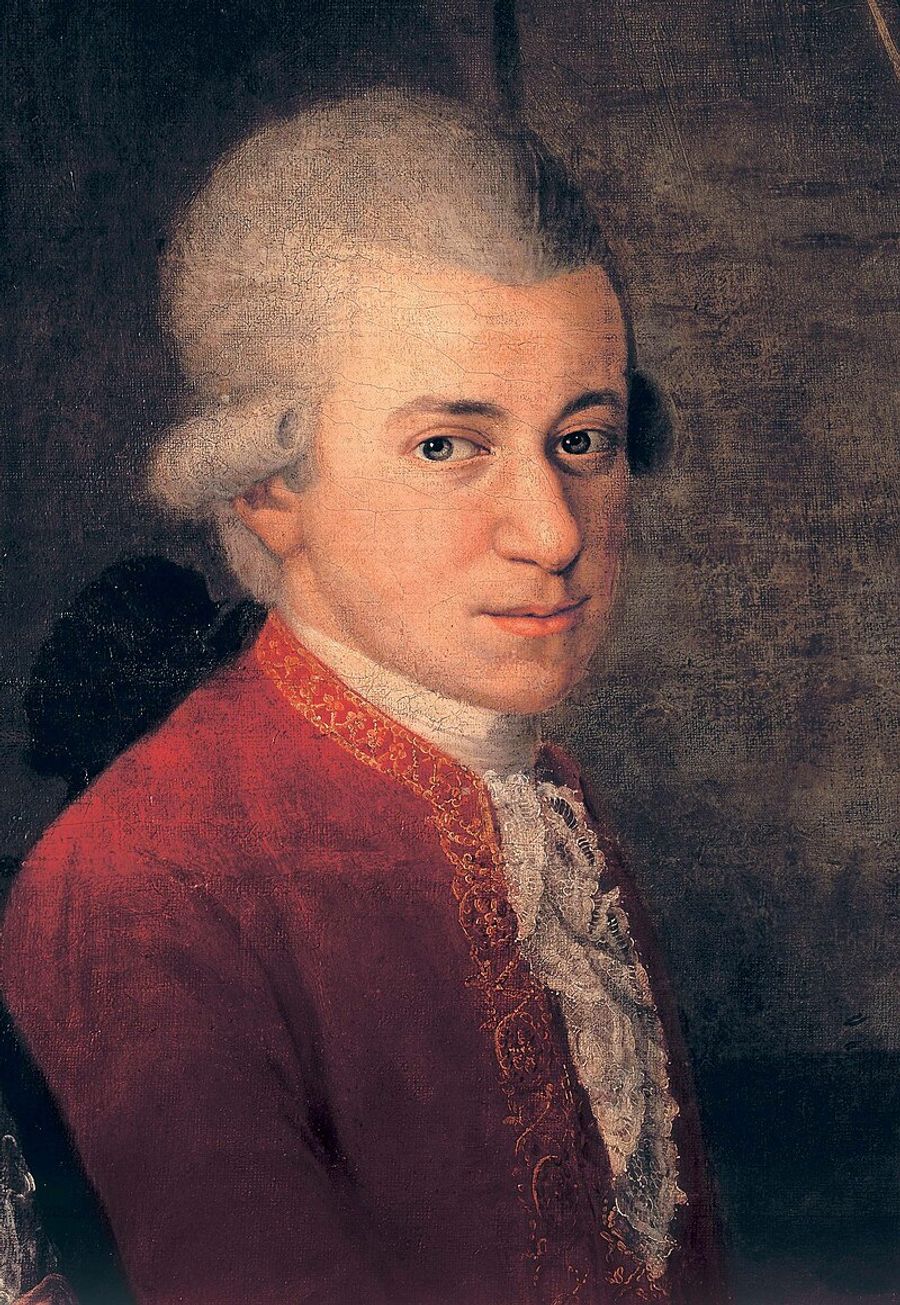
Mozart’s Horn Quintet in E♭ major, K. 407 (1782) is a compact but remarkably imaginative chamber work from his first Viennese year—part concerto, part intimate conversation. Written for natural horn and an unusually dark-voiced string quartet (with two violas), it shows Mozart, aged 26, treating the horn not as a mere color instrument but as a lyrical protagonist.
Background and Context
When Wolfgang Amadeus Mozart (1756–1791) settled in Vienna in 1781–82, he quickly began building a freelance career that depended on performers in his circle: virtuosi who could attract patrons, sell tickets, and—ideally—play his music well. The Horn Quintet in E♭ major, K. 407 belongs to this moment of self-definition. The key of E♭ major, long associated with the horn’s open harmonics and with ceremonial brilliance, suits both the instrument’s natural resonance and Mozart’s taste for warm, spacious sonorities.
Although the horn is often heard in ensembles as harmonic support or hunting-style calls, Mozart here grants it genuine chamber-music agency. Commentators have frequently noted that the outer movements can feel “concertante”—as if a horn concerto had been miniaturized into a salon-sized form—yet the writing repeatedly folds back into true dialogue, with the strings not merely accompanying but rebalancing the musical argument. The result is music that sits intriguingly between genres: intimate enough for domestic music-making, but extrovert enough to sound like a public display-piece in miniature [1].
Composition and Dedication
The quintet was composed in Vienna in 1782 (often dated to the last months of the year) [1]. Mozart almost certainly had a specific horn virtuoso in mind—his friend Joseph (Ignaz) Leutgeb is the usual candidate in modern discussions—but a firm dedicatee is not securely documented in the way it is for some of Mozart’s other occasional pieces. What is beyond doubt is Mozart’s idiomatic understanding of the natural horn: passages lie in the instrument’s comfortable register, exploit ringing open tones, and avoid the assumption of later valved chromatic facility.
Instrumentation (as transmitted in standard editions and reference catalogues):
- Brass: natural horn
- Strings: violin, 2 violas, cello [2]
The scoring is itself a quiet stroke of character. Instead of a conventional string quartet (two violins, viola, cello), Mozart replaces the second violin with a second viola—creating a “lower,” more blended middle register against which the horn can shine without constant competition from bright treble writing. (This also anticipates the sonority Mozart would later favor in his own string quintets, where two violas enrich the inner texture.)
Form and Musical Character
The work has three movements [3]:
- I. Allegro
- II. Andante
- III. Rondo (Allegro)
I. Allegro
The opening Allegro quickly establishes the quintet’s double nature: it can project like a concerto, but it thinks like chamber music. Mozart tends to present the horn in confident, clear-cut statements—tones that speak with an outdoorsy nobility—while the strings supply both propulsion and a softer-grained harmonic chiaroscuro. Especially telling is Mozart’s handling of texture: the ensemble can sound like “horn plus string quartet,” yet it frequently splinters into smaller conversational pairings (horn with violin, horn with viola, strings alone), preventing any single accompaniment formula from taking over.
II. Andante
The Andante is the emotional center: a movement that foregrounds the horn’s capacity for sustained cantabile rather than mere fanfare. Here, Mozart’s decision to keep the string band relatively dark pays dividends; the horn can sing warmly without being forced to shout. The movement often feels like a duet that happens to be surrounded by gentle, cushioning harmony—an effect that aligns with a widespread critical impression of the Andante as unusually inward for horn writing of its time.
III. Rondo (Allegro)
The finale returns to brightness and play. A rondo invites the horn to re-enter repeatedly with a memorable refrain, and Mozart uses that structure to dramatize the instrument’s “public” persona—cheerful, ringing, and theatrically timed—while allowing episodes in which the strings briefly seize the foreground. If the first movement suggests a concerto reduced in scale, the finale suggests the opposite: chamber music enlivened by a soloist’s sense of occasion.
Reception and Legacy
The Horn Quintet, K. 407 has never enjoyed the universal name-recognition of Mozart’s mature string quartets or the later clarinet works, yet it has remained steadily present in the horn repertoire as a rare Classical-era chamber work that treats the instrument as both hero and partner. Its special value lies in how it reframes the horn—an instrument still bound to the limitations (and poetry) of the natural harmonic series—within a refined indoor genre.
Within Mozart’s output, the quintet also illuminates a broader Viennese preoccupation: writing for friends and specialists, and experimenting with hybrid forms that blur public concerto rhetoric and private chamber intimacy. For listeners today, it deserves attention precisely because it is neither a “small concerto” nor a “string piece with horn”—but a poised essay in Mozartian balance, where brilliance is achieved through texture, register, and conversation rather than sheer volume or display.
Sheet Music
Download and print sheet music for Horn Quintet in E♭ major, K. 407 (1782) from Virtual Sheet Music®.
Sources
[1] Mozarteum Digital Mozart Edition (New Mozart Edition/NMA), VIII/19/2: editor’s English preface discussing the period and dating context for the Horn Quintet.
[2] IMSLP work page for *Horn Quintet in E-flat major, K. 407/386c* (instrumentation and basic catalog data).
[3] Wikipedia overview page for Mozart’s *Horn Quintet* (movement listing and general reference facts; used cautiously).