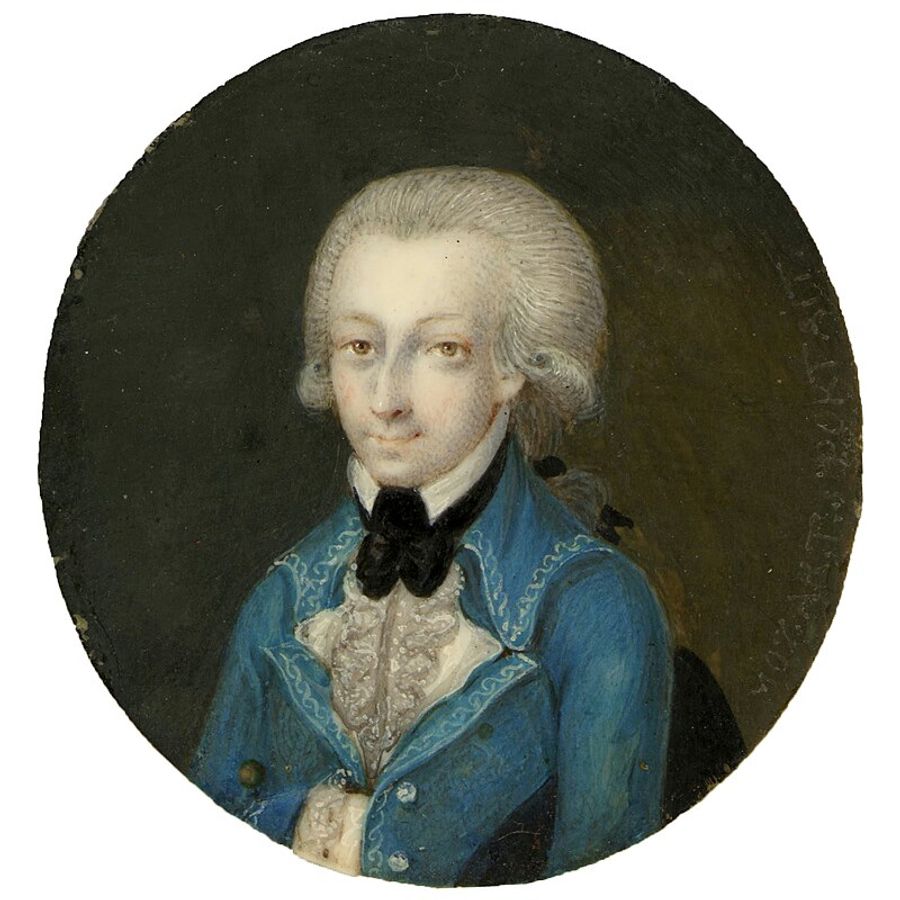
- Köchel Number
- K9 345 | K6 336a
- Genre
- Opera & Stage Music
- Form
- Operas & Singspiels
- Date
- 3 October 1773
- Place
- Salzburg
- Age
- 17
Mozart’s Choruses and Entr’actes for Thamos, König in Ägypten (K. 345/336a) are substantial incidental music for Tobias Philipp von Gebler’s “heroic drama,” begun in 1773 in Salzburg-era circumstances and later expanded for Salzburg performances in the later 1770s. Though not an opera, the score thinks theatrically—using chorus, orchestral interludes, and ritualized sonorities to project a solemn, quasi-ceremonial world that foreshadows Mozart’s mature stage manner.
Background and Context
When Wolfgang Amadeus Mozart (1756–1791) composed music for Tobias Philipp von Gebler’s five-act spoken drama Thamos, König in Ägypten, he was still a Salzburg-based court musician in all but name: brilliant, prolific, and constrained by the archiepiscopal environment. The resulting work—catalogued as K. 345 (also K. 336a in earlier Köchel numbering)—is best understood as incidental music: choruses and orchestral entr’actes designed to frame, intensify, and ritualize the spoken play rather than replace it with sung-through opera.[1]
The play itself has never held the stage as securely as Mozart’s music has held the concert hall. Yet this is precisely why Thamos deserves attention. It shows Mozart, at 17 and then again a few years later, experimenting with a dramatic idiom midway between courtly theatre, opera, and ceremonial spectacle. Modern listeners often hear in Thamos a pre-echo of the moralizing, temple-centered world of Die Zauberflöte (1791)—not because the musical language is identical, but because Mozart is already testing how chorus and orchestra can signify authority, mystery, and enlightenment-style virtue.[2]
Composition and Commission
Gebler—an Austrian playwright and diplomat—commissioned Mozart to supply music for Thamos during 1773, when Mozart was in Vienna for part of the summer; by the time the drama appeared in Vienna in April 1774, at least two choruses existed.[2][3]
What makes the work unusually fascinating is its layered chronology. Scholarship and performance history point to an early “Vienna” nucleus (choruses) and a later Salzburg augmentation in which Mozart supplied (or revised) much of the inter-act orchestral music for a local staging (documented for 3 January 1776), with further work and refinement around 1779–80.[4][1] For audiences, this means Thamos is not a single stylistic snapshot; it is a small dossier of Mozart’s evolving theatrical thinking, spanning the years just before and just after his first major Salzburg maturity.
Although Köchel 9 commonly lists the work as K. 345, the older designation K. 336a remains widespread in editions and recordings—an artefact of how Mozart’s scattered stage pieces were later reorganized by cataloguers and editors.[1]
Libretto and Dramatic Structure
Gebler’s Thamos is a spoken heroisches Drama in five acts, set in an imagined Egypt where dynastic legitimacy, priestly authority, and moral testing drive the plot. Mozart’s music does not aim to provide continuous commentary; instead, it enters at strategic points—above all through choral invocations and interludes that function like ritual “tableaux.”
The drama centers on the young ruler Thamos and the revelation of true identity and rightful succession, overseen by Sethos, high priest of the Temple of the Sun. Notably, Mozart’s score singles out Sethos as the only specifically named role in the music; beyond him, the vocal writing belongs largely to chorus (with additional solo voices used as needed).[1]
This distribution of forces is already a clue to the work’s distinctive profile. Where opera typically individualizes emotion through arias and ensembles, Thamos often collectivizes meaning: the chorus speaks for priests and priestesses, for public judgment, for a community’s moral horizon. In Enlightenment drama, such choral writing can represent reason, law, or sacred authority—concepts that, later in Mozart’s career, become central to his most celebrated theatrical finales.
Musical Structure and Key Numbers
In performance and on recordings, Thamos is usually encountered as a sequence of independent numbers: orchestral entr’actes (between acts) and major choral scenes. The complete set is commonly presented in seven sections in modern cataloguing.[5]
Three aspects make the music particularly distinctive within Mozart’s stage output of the 1770s:
1. An operatic seriousness applied to spoken drama. Even without recitatives and arias, Mozart writes with an operatic sense of pacing: strong contrasts, sudden turns to darkness, and emphatic cadential rhetoric that “lands” like stage lighting cues.[2]
2. Chorus as ritual authority. The choral writing often sounds less like festive Salzburg church music and more like theatre-as-ceremony—broad phrases, homophonic proclamations, and textures designed for clarity and weight.
3. Entr’actes as psychological framing. The interludes do more than fill time while the stage resets; they establish emotional temperature for what follows—sometimes urgent, sometimes ominously suspended.
Among the best-known excerpts is the final chorus, “Ihr Kinder des Staubes, erzittert” (“Children of dust, tremble”), which has long circulated separately and is frequently cited as the score’s dramatic summit.[1]
Forces (overview)
Exact scoring varies by number and by edition, but the work is fundamentally written for soloists (SATB as required), mixed chorus, and orchestra—a telling blend that aligns it with both theatre and ceremonial styles.[5]
Premiere and Reception
The earliest documented Vienna performances of Thamos date from April 1774 at the Kärntnertortheater; evidence suggests that only two of Mozart’s choruses were available at that point.[3] The play itself did not become a durable repertory item, and the relationship between specific stagings and the evolving musical materials remains complex—one reason the work’s chronology is still discussed in Mozart scholarship.[1]
In Salzburg, a notable performance took place on 3 January 1776, when the drama was staged with musical accompaniment by the court orchestra under Michael Haydn’s direction; later Salzburg revivals around 1779–80 are often associated with the expanded interludes and the work’s “final-form” choral complement.[4][1]
Reception history is, in a sense, a tale of two works: Gebler’s drama, and Mozart’s music. The play drew limited enthusiasm, but the incidental score proved portable—capable of being reused, excerpted, and ultimately detached from its original theatrical context.[2] That portability helps explain Thamos’s afterlife: the entr’actes and choruses function almost like a compact “dramatic cantata” for concert use.
Today, Thamos, König in Ägypten stands as one of Mozart’s most compelling early encounters with large-scale choral theatre. It is not a “hidden opera,” but it reveals the young composer discovering how a chorus can embody a moral community and how orchestral interludes can shape a narrative’s inner pulse—techniques that will return, transfigured, in the great stage works of his final decade.
Sources
[1] Overview of the play, Mozart’s incidental music (K. 345/336a), roles, and early performance context.
[2] Program-note style discussion of commission (1773), Vienna performance (April 1774), Salzburg performances, expansion for later use, and aesthetic context.
[3] Catalogue listing with dates and early performance note (including that the 1774 Vienna performance used only two choruses).
[4] Scholarly project note on the 3 January 1776 Salzburg staging and the multi-stage genesis (early choruses vs later interludes), with contextual references to NMA scholarship.
[5] IMSLP work page summarizing genre, forces (voices/chorus/orchestra), and commonly presented sectional layout.