- Köchel Number
- K9 30 | K6 30
- Genre
- Chamber Music
- Form
- Violin Sonatas & Variations
- Key
- F Major
- Date
- February 1766
- Place
- The Hague
- Age
- 10
Mozart’s Violin Sonata in F major (K. 30) belongs to the set of six “sonatas for keyboard with the accompaniment of violin” composed in The Hague in early 1766, when he was just ten years old [1]. Often treated as modest juvenilia, these works repay closer attention for the way they translate the public, tour-honed brilliance of the child prodigy into an intimate domestic genre—music designed as much for aristocratic salons and music rooms as for the concert platform [2].
Mozart’s Life at the Time
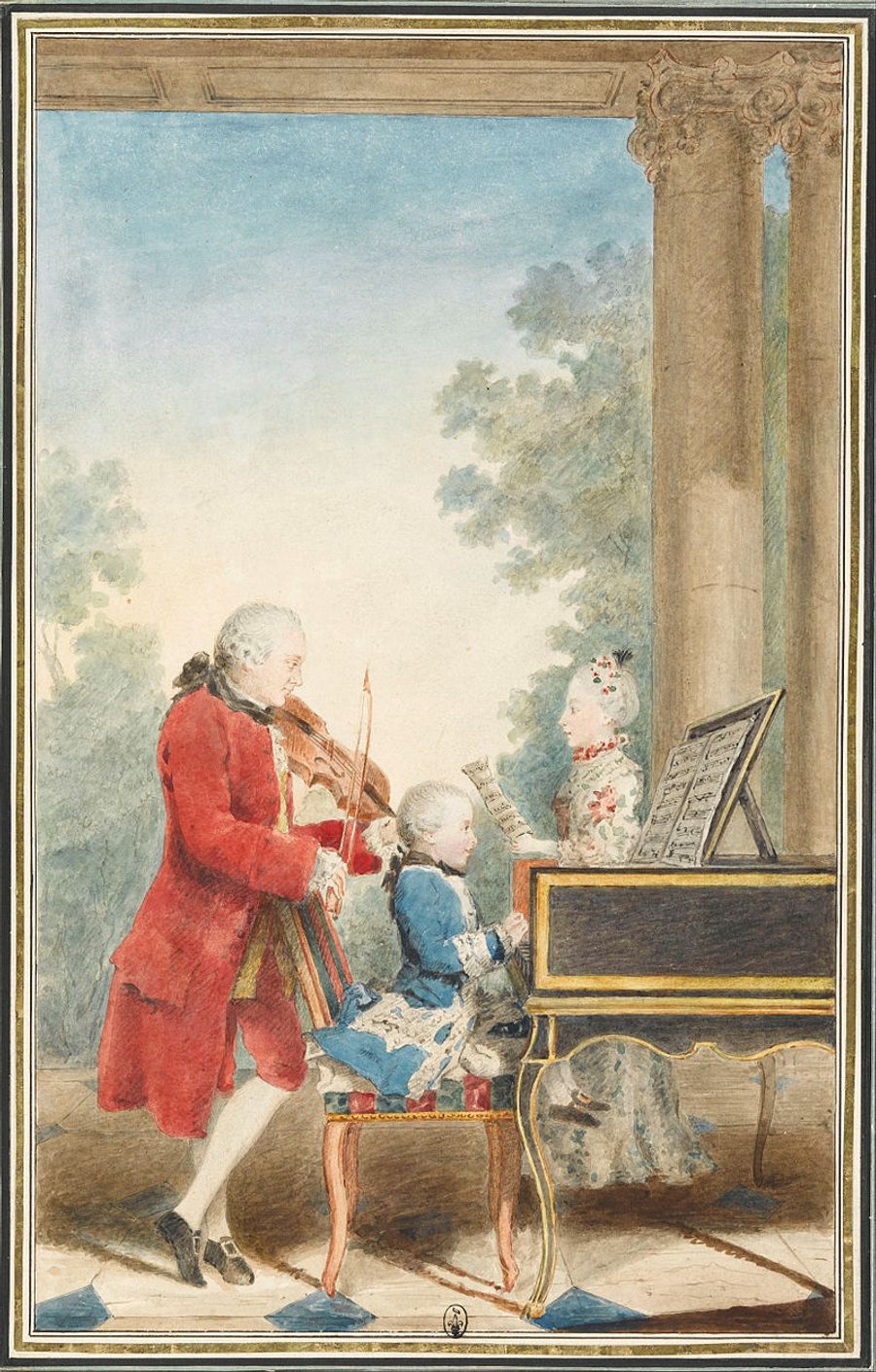
In 1766 the Mozart family were nearing the end of their long “Grand Tour” (1763–66), a sequence of court appearances and public concerts that had made the young Wolfgang Amadeus Mozart (1756–1791) famous across Europe [3]. Their Dutch sojourn brought them to The Hague—seat of government of the Dutch Republic—largely because the regent Princess Carolina of Nassau-Weilburg wished to hear the children perform [4].
The Hague months were also shadowed by illness. Contemporary documentation records severe sickness within the family during their stay, with recovery and convalescence stretching over weeks [4]. Against this backdrop, the keyboard-and-violin sonatas (K. 26–31) read not simply as “student works,” but as practical repertory: adaptable, publishable pieces suitable for courtly audiences, and tailored to the domestic keyboard culture that sustained music-making in aristocratic households.
Composition and Manuscript
K. 30 is one of the six sonatas K. 26–31, composed in The Hague in early 1766 and issued with a dedication to Princess Carolina—an unusually clear sign of a specific patronal context for Mozart’s juvenilia [1][2]. The very title under which such works circulated—sonatas for keyboard “with the accompaniment of violin”—signals the balance of forces: the keyboard leads, while the violin reinforces, converses, and brightens the texture rather than competing as an equal partner.
Today the sonata is best known through modern editions and widely available prints (including digitized scores), which have helped keep this early repertory within reach of students and performers interested in Mozart’s formative years [5].
Musical Character
K. 30 is compact and genial in F major, projecting the clarity and poise expected of mid-18th-century salon music—yet it also shows Mozart learning how to create momentum with minimal means. The thematic writing tends toward clean, singable ideas; sequences (patterned repetitions at new pitch levels) provide forward drive; and the keyboard frequently carries the argument while the violin supplies color and emphasis.
A useful way to hear the sonata is not as a “small” predecessor of the mature Viennese violin sonatas, but as a document of genre. In the 1760s, the keyboard sonata with violin accompaniment was a social medium: music for skilled amateurs, for teaching, and for display in private rooms. Within that frame, K. 30 deserves attention for its economy—how swiftly it establishes character—and for its instinctive grasp of dialogue, even when the violin part remains largely supportive.
Instrumentation (as conceived in the 1760s publication tradition):
- Keyboard: harpsichord (or fortepiano in later practice)
- Strings: violin (ad libitum accompaniment)
In short, Violin Sonata No. 15 in F major, K. 30 is not a “miniature masterpiece” in the later sense; rather, it is a finely judged tour-era work that shows Mozart at ten already thinking like a professional: writing for real patrons, real players, and real musical situations—and doing so with a naturalness that helps explain how quickly the child became a composer of substance [1][4].
Sources
[1] Overview of the six Hague violin sonatas (K. 26–31) and the specific entry for K. 30.
[2] MozartDocuments: publication and dedication context for the Hague sonatas (K. 26–31) and related Dutch works.
[3] Background on the Mozart family’s Grand Tour (1763–66), including the Netherlands period.
[4] MozartDocuments: documentation on the Mozarts’ arrival in The Hague, patronage circumstances, and illness context during the Dutch stay.
[5] IMSLP work page for *Violin Sonata in F major, K. 30* with digitized scores/parts and publication metadata.