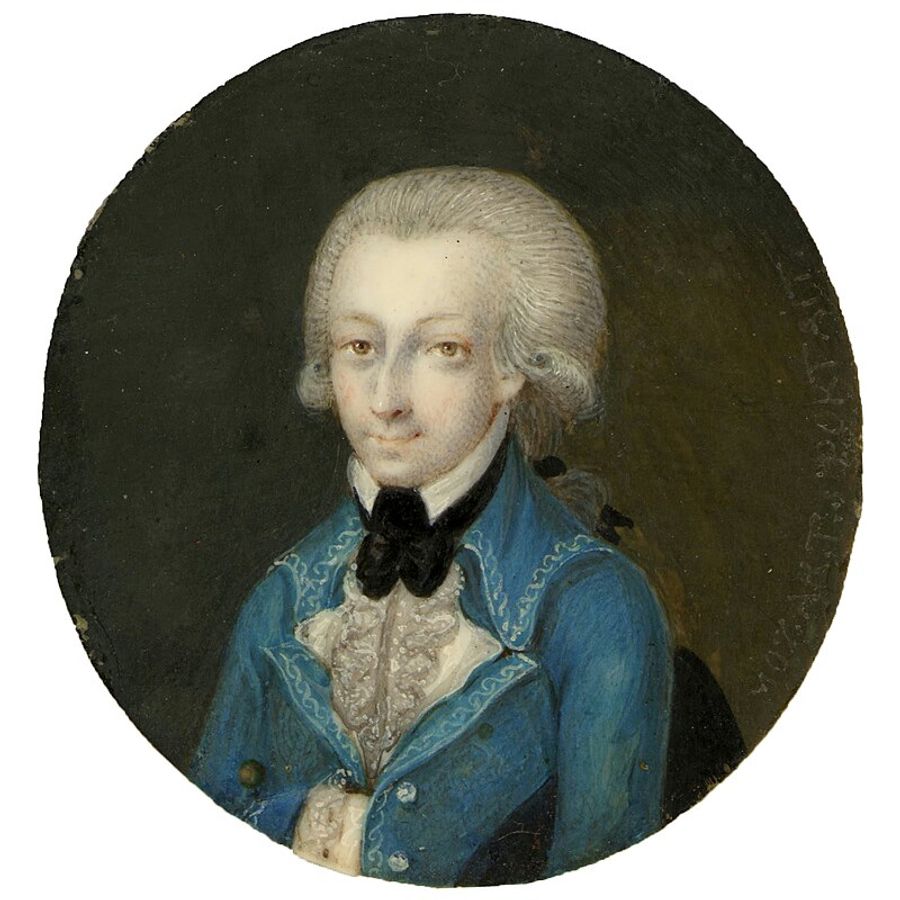
- Köchel Number
- K9 248 | K6 248
- Genre
- Divertimenti & Serenades
- Form
- Divertimenti for Strings & Winds
- Key
- F Major
- Date
- June 1776
- Place
- Salzburg
- Age
- 20
Mozart’s March in F major, K. 248 is a compact ceremonial piece composed in Salzburg in June 1776, when the composer was 20. Closely linked to the Lodron family’s outdoor festivities, it shows how Mozart could bring crisp rhetoric, bright horn color, and a touch of virtuosity to a genre designed for practical function as much as for listening pleasure.
Background and Context
Mozart’s Salzburg years were shaped by employment obligations (to the archiepiscopal court), local aristocratic patronage, and a steady demand for music meant to be used: for name-day celebrations, garden entertainments, processions, and other semi-public occasions. In that ecosystem, the march was not a symphonic “movement” in disguise but a functional genre—music that could do a job (cue an entrance, accompany a ceremonial walk, provide a festive sonic frame), while still reflecting the composer’s craft.
K. 248 belongs to Mozart’s small but telling group of marches associated with serenades and divertimentos. A scholarly overview of this “serenade-linked” practice explicitly pairs K. 248 with the Divertimento in F, K. 247, situating the march within the wider Salzburg tradition of occasional outdoor music in the 1770s.[1] The work is therefore best understood not as an isolated miniature but as one component in an evening’s social ritual—an audible signal that “the music is arriving” (and later, departing).
Composition and Premiere
The Köchel catalogue entry maintained by the Internationale Stiftung Mozarteum dates the work to Salzburg, June 1776, and preserves its status as an authentic, extant composition.[2] Although many such marches circulated without clear performance documentation, K. 248 has an unusually firm contextual anchor: modern editorial commentary (Henle) treats it as belonging to the same occasion as K. 247 and suggests a specific function—accompanying the arrival and departure of the musicians.[3]
Henle’s notes further connect this Lodron celebration with a documented first performance of the related Divertimento, K. 247, on 18 June 1776 in Salzburg; K. 248 shares date, key, and scoring, and thus plausibly served as the ceremonial “frame” for the entertainment.[3] Even when heard today as a standalone concert opener, the march still carries that original social logic: it is music written to project clearly outdoors, to sound festive without requiring concentrated listening, and to make a small ensemble feel “official.”
Instrumentation
K. 248 is scored for a classic Salzburg outdoor sextet—two horns plus strings—ideal for brilliance and carrying power without the logistical burden of a larger orchestra. The Mozarteum’s catalogue gives the instrumentation succinctly as horns, two violins, viola, and basso.[2]
- Brass: 2 natural horns (in F)
- Strings: 2 violins, viola
- Bass: basso (typically realized by cello and/or double bass in performance practice)
This scoring is more than “lightweight.” In the 18th-century Salzburg context, such divertimento-and-march ensembles were often played one-to-a-part, giving the music a chamber-like transparency while still retaining outdoor resonance through the horns.[2]
Form and Musical Character
K. 248’s purpose encourages brevity and immediate recognizability. Its musical interest lies in how Mozart animates a conventional ceremonial profile with details that catch the ear: the horns’ bright harmonic punctuation, the clean phrase structure, and the sense of forward motion that makes the piece feel like a confident procession rather than mere background.
A “functional” genre—handled with care
As march music, K. 248 is expected to emphasize:
- Clear periodic phrasing (easy to follow while moving)
- Strong tonal rhetoric (stable cadences, bright key)
- Projection and color (the horns’ open-air sonority)
Yet Mozart rarely leaves such expectations untouched. Scholarship that surveys Mozart’s marches in context places K. 248 among works explicitly designed to join (or frame) larger divertimento/serenade structures—music that is practical, but not musically anonymous.[1]
Why it deserves attention
K. 248 is not “famous,” but it is revealing. It shows Mozart at 20 writing for real social conditions: limited forces, outdoor acoustics, aristocratic etiquette, and a need for music that can command attention instantly. In that sense, it belongs to the same creative world as the Salzburg serenades and divertimentos—genres in which Mozart learned to balance immediacy with surprise, and to make small ensembles sound ceremonial.
He also writes for a distinctive instrument family combination. Two natural horns in F are not merely harmonic support; in this repertoire they provide the emblematic public sound—something like musical livery. The strings can supply agility and articulation, while the horns give the music its civic sheen.
Reception and Legacy
Pieces like K. 248 live a double life. In their own time they were woven into events (name days, garden festivities, aristocratic evenings) and valued for fitting a ceremonial moment. In modern listening culture, detached from that function, they risk being dismissed as “occasional.” But Mozart’s occasional music is often the best window into how 18th-century musical life actually worked—and K. 248 is a particularly neat specimen because its connection to K. 247 and the Lodron milieu is so consistently emphasized in modern cataloguing and editing.[2][3]
For performers and listeners today, the march’s value is straightforward: it is a concise, bright, and historically grounded opener (or interlude) that can sharpen the profile of a program of Salzburg divertimentos. Heard before or alongside Divertimento in F, K. 247, it regains its original rhetorical role—announcing an occasion, setting a tone, and reminding us that Mozart’s craft extended well beyond the concert hall.
Sources
[1] János Kárpáti, “Mozart and the March” (Studia Musicologica 60, 2019) — includes a table pairing K. 248 with Divertimento K. 247 and giving NMA references for the march group.
[2] Internationale Stiftung Mozarteum, Köchel-Verzeichnis entry for KV 248 — dating (Salzburg, June 1776), authenticity, and instrumentation (2 horns, 2 violins, viola, basso).
[3] G. Henle Verlag edition page (HN 1150) for March K. 248 and Divertimento K. 247 — editorial context: Lodron name-day occasion, same date/key/scoring, and presumed function as musicians’ entrance/exit music; first performance date for K. 247 (18 June 1776).